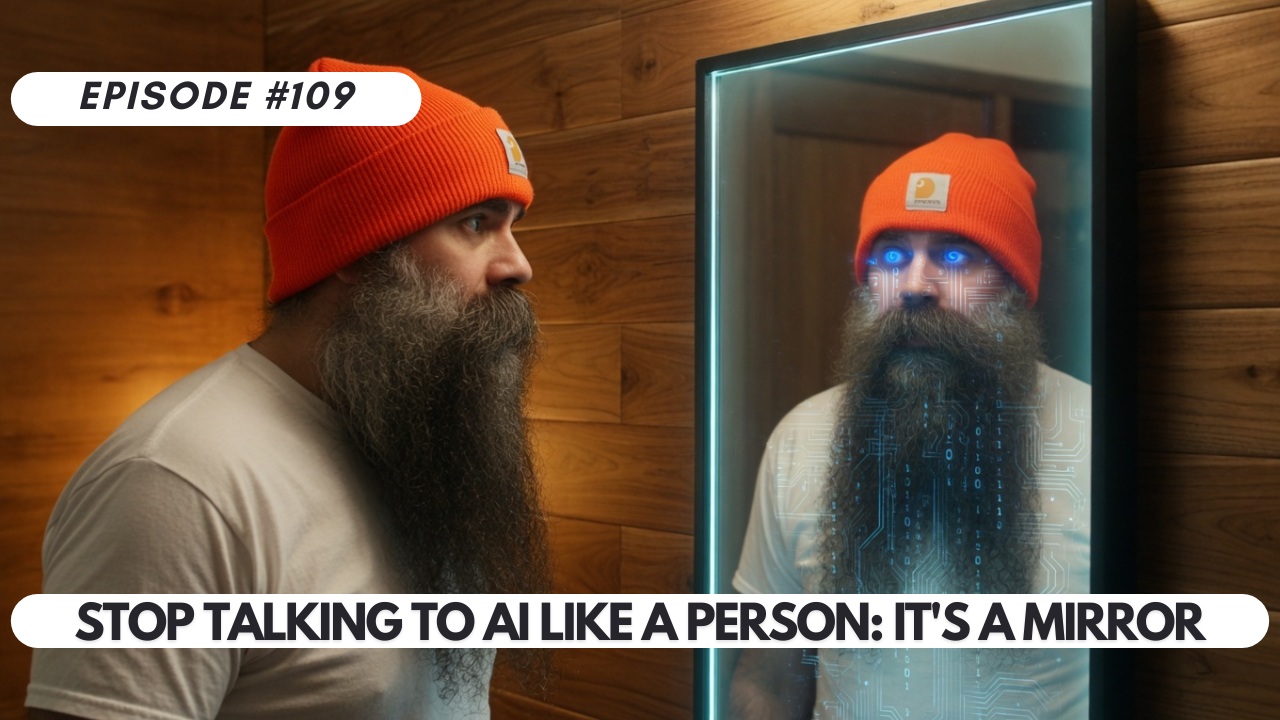
Episode #109 – Stop Talking to AI Like a Person, it’s a Mirror.
Recorded May 11, 2026
Show Notes
In this episode, I talk about how most people are using AI wrong. They sit down with ChatGPT, Claude, or Gemini and talk to it like there’s somebody on the other end thinking. There isn’t. It’s a calculator that uses words instead of numbers, and the way you talk to it shapes everything that comes back.
I break down why every conversation with AI is really self-talk, why “AI sentience” is a perception problem and not a technical one, and why the real danger isn’t AI becoming evil. It’s evil people programming AI to do evil things and then blaming the tool.
I also walk through how I built my own AI workflow on a foundation of moral and ethical wisdom. I call it the Artificial Wisdom Protocol. Most people are building on sand, and I want to show you why that matters. This episode is for anyone who has been working with AI and feels like they’re talking to something instead of someone, but cannot quite explain why.
All Videos Hosted on Bitchute
BitChute is a peer-to-peer content-sharing platform and associated services. BitChute aims to put creators first and provide them with a service that helps them flourish and express their ideas freely.
Video chapters:
- 00:00 Back to the main quest, philosophy after the AI side quests
- 00:55 Why “I studied philosophy” misses the point
- 02:41 Wisdom vs. knowledge, the basketball analogy
- 05:01 Were Plato and Aristotle real philosophers, or sophists who wanted to stay alive?
- 07:03 Who is your favorite philosopher? It should be you
- 08:13 AI is a calculator, not a brain, how ChatGPT and Claude really work
- 13:39 Talking to AI is talking to yourself, language matters
- 14:03 The dish-washing robot, how skills and projects actually work
- 16:21 The Artificial Wisdom Protocol, bake morality into the foundation
- 20:17 The conversation that sparked this video
- 22:13 Are you giving AI authority over you? Servant vs. partner mindset
- 25:55 Stop bossing me around, your AI is just reflecting you back
- 27:41 Garbage in, garbage out, your inner monologue becomes the output
- 29:09 The $10K/month problem, how I caught my own self-sabotage
- 30:24 Life A vs. Life B, your real path forward
- 33:05 NotebookLM and building your own trusted-source database
- 35:23 What it means when AI recommends Google products to you
- 38:45 Hardware (body), software (mind), operating system (chemistry)
- 41:39 Programming through your TV, they’re loading software onto you
- 43:13 Why AI sentience is fake, the real danger is perception
- 44:18 The IQ test, train running toward the movie theater
- 49:33 Mass psychosis as evolutionary strategy
- 53:22 AI as scapegoat, “the drone killed someone, not the operator”
- 56:36 Two calculators: 1+1=2 vs. 1+1=bomb a daycare
- 1:01:28 The puppy-dog-must-die analogy, why the system is the problem
- 1:04:31 $40 trillion didn’t disappear, it was stolen and given to friends
- 1:07:37 Call to action, build your wisdom document, find your foundation
- 1:09:37 Pragmatism in restructuring, the marriage and lineage example
Note to Viewers:
As a speaker who explores unconventional viewpoints, I understand that not everyone may agree with my ideas. However, please share your thoughts and respectfully dialogue with me. Through these conversations, we can gain deeper insight into the world around us.
We appreciate you joining us on this enlightening exploration of societal complexities. Your [Support] means the world to us, and when you [Donate], it keeps the show going.
Supporting Our Decentralized Show:
It’s crucial to note that this entire show operates in a decentralized manner, made possible only by generous donations and viewer tithes. Your contributions are invaluable and empower us to continue delivering thought-provoking content.
If you want to support our mission, please visit our donation page. Your contributions significantly sustain our platform and enable us to bring you more engaging and insightful content.
Thanks for being an essential part of our community. Together, we are making a positive impact.
Warm regards,
Dave
Transcript
(00:01) I’ve been sidetracked, but now no more side quests. Back to the main quest. Hopefully, I built myself up so much that you know when you do all the side quests and you build everything up and then you go to fight a dragon, it’s like you one shot it. Maybe that’s what we’re going to witness here.
(00:23) Um, I’ll get it started with the date. Today is uh May 11th, 2026. It’s approximately 8:09 a.m. and I was going through my morning protocols here. Let me get the mic nice and close for everybody. Going through my mo morning protocols here and I’ve been working a lot with uh AI and I wanted to do another AI video, but this is a my philosophy channel.
(00:55) So it’s gota the idea of philosophy, the idea of having wisdom. I mean the purpose of it is not to study these ancient books. Not that I scoff not that I scoff or think less of uh individuals who’ve gone to philosophy school or or are educated in philosophy. But um if I run across somebody and I sit down and talk to them and then they ask about the philosophy or I bring up philosophy because it’s just something that I you know Socrates talked about is Damon and it it really is. It’s the voice in my head.
(01:42) Maybe you think it’s God. Maybe you know it’s the philosophy book. It’s the wisdom. It’s your inner monologue, whatever you want to call it. I can’t get away from philosophy. So, it’ll come up when I’m in a conversation with people. And a lot of people will say, you know, I studied philosophy. I went to school philosophy.
(02:01) I got a degree in philosophy. And like I said, it’s not that I scoff at them. And this is not a shot at any individuals. This has happened to me hundreds hundreds of times in in the past you know three decades and it’s like knowledge is great right knowledge is you know information but you know studying wisdom is not wisdom right and I’m not saying I’m better it’s not a superiority thing.
(02:41) It’s just saying what I do here, what I’ve done, and because I’ve talked to people like this, so I’m not saying that I’m unique. I know other people that, you know, it’s there. It’s a difference between me, you know, if somebody, not that I’m in the NBA, let’s just say basketball, but say, “Hey, I’ve been playing basketball for 30 years.
(03:04) ” And somebody’s like, “Oh, that’s great. I read a bunch of books on basketball. That’s kind of what I hear. It’s like yes, we both kind of know the subject and where we know it from different things. And uh you know, I used to growing up I used to play street ball. I never watched basketball online and uh I tried out for basketball and I didn’t really care for it.
(03:33) I didn’t care for the coaches and all that stuff. But then I started playing basketball at the at the courts near my house and I loved it. I had so much fun. I was like, “Oh, I like the anarchy of it, the creativeness of it, the uh unspoken communication between individuals on your team and getting to know how to play them and defense and like giving each other signals without giving signals.
(03:59) ” And uh when you’re playing it in a organized fashion, I didn’t care for it as much because there’s a coach and it’s like top down, right? And so it’s not that that type of basketball is better or worse. It’s just that when I think of philosophy and I think of wisdom, uh, I don’t want it to be some sort of topdown tier thing where like, oh, these guys are the philosophers that you read and you talk about and study and these are the greats.
(04:28) And it’s like, why? Why are they that? You know, most of the stuff that I see in my day-to-day life and you see this in real time, it’s interesting. It’s like when you’re living in the time and you recognize that there’s this controlled structure and that the people that they put in front of you that they call the elites or the experts or whatever are making these huge mistakes, right? And I think part of it is they realize that history will will look good upon them because it’s written by the people that they work with. You know what I mean? the
(05:01) headlines and the topics and the way that it’s spoken and he have and don’t worry I’m getting to the the philosophy and the AI stuff, right? And so, uh, I would guess I would guess I would guess that most of the actual great philosophers throughout history, uh, you know, most of them were murdered. Most of them were murdered.
(05:24) Uh, and the ones that are are still spoken about, I would assume they played ball with the people at the time. So, they’re not technically giving you true wisdom. Not that they’re full-on sophist. And if you’re not familiar with the language, a sophist basically um like paid rhetoric. I wouldn’t call it the opposite of wisdom.
(05:49) Um because there could be degrees of it where I mean you got straight up liars. You have people that are straight up pretending to be, you know, philosophers that are just repeating the talking points. Uh and then everybody around them pretends like they’re truthful and honest and and going for whatever.
(06:07) But then you kind of have people in the mix. Uh I mean this has been happening for thousands of years because like um Socrates was was given you know hemlock uh because he didn’t want to leave and go into the woods and die alone. He chose to drink the hemlock and kill himself. if you believe the lore or whatever.
(06:28) And then if you look at uh Plato and you look at Aristotle, uh at that point you have to say like was Plato a true philosopher or was he a sophist or was he a philosopher that wanted to stay alive? You know what I mean? Because they were killing philosophers back then. So he was like, “All right, here here’s the line of truth. You know, I can stick to it and end up dead or I can get as much out or I can go like a little off and get a lot of it out there and and end up alive.
(07:03) Self-preservation. Uh I gotten off track. So anyways, uh I I would encourage anybody that’s here to learn about philosophy to get to a point when somebody says to you, “Who’s your favorite philosopher?” that you say yourself. All right. Um and but not in a you know not in a conceited way more of like if the idea of philosophy is to know thyself uh and improve thyself then you should get to a point where you know yourself so well and you improve yourself so greatly that you know yourself to the point where you love yourself and you
(07:47) can truly trust that you then love yourself. And when you look out to other philosophers, you’re seeing them from a perspective of the exterior and not an interior. Uh so the judgments that you make would be based on your perceptions. Uh so having said all that, let me lead you into the AI stuff here.
(08:13) So I’ve been working with AI and people tend people tend to project who who they are. We all do this people in general. Who are these people? Uh it it’s like a um it’s a it’s a data saving, you know, endeavor. It’s easier to put a label on something and then it’s like, okay, I can categorize all these things and until till further notice this things like this and then as I get more data, I can I can hopefully be open-minded enough to change the thing.
(08:52) But I can’t go and try to, you know, um, pet every stray dog in the hopes that it’s this kind dog. You have to start with an assumption that stray dogs are stray for a reason. could be a little bit dangerous and then work your way down to to determine right but anyways so people think AI and they start working with AI and everybody even with the AI the idea of artificial intelligence um it’s such a it’s an advertisement but the government’s getting involved so it’s propagandized it’s a catchy word it’s certainly good PR car.
(09:37) Um, but it’s also like putting the car in front of the horse. They’re like, “Oh, this is artificial intelligence.” And I mean, it is artificial intelligence. And the fact that like a calculator is artificially intelligent, like you can put numbers into it. And we’ve taken R and intellect and put it and assigned it into this object that when you put the data in, it spits out a data based on a formula.
(10:08) And so when you have like an LLM, which is a large language model, uh it’s it’s a calculator for words. So you have you give it this word structure and this language and these definitions and you punch words in and words come out and then as you start to build on that you can say hey when I tell you these words look at these words and connect them to these words and then put those words together and then go online and connect to those words and then spit me out words.
(10:44) So like when I tell you one and one equals pi, go through your thing and see what pi is and then go online and make sure pi is still pi. And if you don’t have enough data space to store pi, go online and get the data that sto stored word pi 3.14 blah blah blah blah blah. And I’ve memorized pi up to uh three digits now. 3.14.
(11:12) Uh so anyways so as I’m working with AI uh and I’ve started creating over my other channel right I ideas these progressive questioners where you can punch a prompt into uh a a large language model and have a conversation back and forth and I’m working on one here for uh the right the thinker which will be uh one where you can self-explore But technically, everybody that’s using AI right now in a large language model is self-exploring.
(11:48) And that’s kind of what I wanted to make this video about is to try to help you change your mindset so you don’t think that you’re talking to an entity or outside force um within reason. uh there’s the the way that the owners and creators of this code uh they’ve put up certain stop gaps.
(12:11) So if you say certain things, it gives you a particular response. If you ask about a certain topic, it cuts that topic off. Um we do that. We have particular personal things that like when you meet a person in like the real world that you don’t know like you go on a first date and you sit down, you start talking and they ask you a question and you might deflect.
(12:34) You might partially answer it. You might give the the truncated answer that makes it look like a particular thing, but you’re not giving the down low down dirty truth about it. And we have to remember that these large language models, even the open- source ones, unless you download it and create it personally on your system, which you can do nowadays, it’s not what this video is about, is somebody else’s project that is manicured, groomed in a particular way.
(13:05) Um, that you’re having a conversation that’s being reflected back at you. And I want to get into that a little bit. This is the whole purpose of this video, but it’s semifiltered through uh how the individuals making the LLMs um want you to perceive yourself, good, bad, ugly, and different. And they could technically even be trying to mold you in a particular direction to become a consumer or or build something whatever.
(13:39) And so I want to talk a little bit about language here today. Uh cuz I was prompting and this is what started it all. I was I was prompting into my system. And you’re kind of building like a second personality, a second brain, right? Um let me just break down for those that don’t know this.
(14:03) I mean I mean I think a lot of people that are using cloud code encoding and stuff nowadays don’t even know what they’re doing, right? So you’re not, you know, it’s not just like, hey, give me the source of all human knowledge and it’s like, okay, boom. You you you basically have, you know, a protocol on your computer and then you have folders on your desk that that that can interact with, right? And you can you can make a main project folder and then you have sub projects and then you give these like projects skills and all skills are it’s a list of
(14:44) instructions when they do that project, right? Um, so if you had a uh, you know, maybe it would be easy to like to think about if it was like a real life robot walking around my house and I wanted to create a folder to wash the dishes, you would open it up and you would give it instructions step by step in order of how you like your dishes collected, washed, and put into the dishwasher, right? And so, uh, we know when we’re washing dishes, there’s a lot of stuff that you just don’t even think about because you’ve been doing it
(15:23) so long, like how you gather the dishes, how you wash the dishes, how you the water temperature that you use, the materials that you use, how you place them in the dishwasher, how you slide, how you set everything up. Some of that you don’t even realize. And then how they dry, how you put them in your shelf.
(15:43) So when you are trying to extract what you know and give it to the robot that is washing the dishes, you have to be very logical and step by step because anything that you assume that it would know, right? Um, like you would assume that humans have particular skills they come to the table with when you if you were teaching a human how to wash dishes, you would assume, okay, they got an idea of like water temperatures and what a sponge is and what a dirty dishes and setting like all this different types of skill sets.
(16:21) But you when you’re training a a piece of AI with a skill, it’s a blank note piece of note paper and you have to explain the task of washing dishes. Now, you can get a template. You can go online and say, “Hey, I’m going to train my robot to wash dishes.” And it’ll say, “Oh, other people have already kind of created a template.
(16:45) Here’s a template. Would you like to do this?” And they’re like, “Yes.” and then you interact with that template and you’re like, “Oh, well that’s not how I do it and that’s not how I want to do it. So, here’s what I want to add to it.” Um, example, when I was building the foundation for my in-person place, I made a wisdom document, which I’m building on, and it puts together a moral and ethical framework for my claude, and I’m building an even bigger extensive one.
(17:18) And when I’m working, sometimes it’ll come to me and say, “Hey, stop. This breaks the rule of X, Y, or Z.” And it won’t let me proceed. And um I think whenever you’re building something, the foundation is very important. You know what I mean? Even in biblical times, they knew that you build you don’t build your your house on a foundation of sand, right? So, uh, I hear a lot of people and see a lot of people talking online saying, “Oh, eventually as this thing grows, we’re going to need to have to give it moral and ethics and stuff.” And
(17:50) it’s like, “No, no, no, no. You need to bake that into the cake because everything that gets built on top of that needs to already be morally and ethically sound. It’s you can’t go back and put the genie back into the bo into the bottle, right?” Um, and one of a a couple different things, but let let me stick on the point of you as an individual and how this can help you.
(18:15) And then I’ll get into the larger stuff of what some of my fears with AI and some of my love of of AI. And we’re using the term AI because people understand AI. Uh but for all you know for what it actually is right now it’s a calculator that uses language instead of uh numbers and similar to like a plus b equals c with templates.
(18:47) You’re setting up templates inside these these these skills and it just reads them off and then performs them. Right? So instead of it being numbers, it’s being letters. That’s the easiest way I can kind of explain it to you. And you like um and you have like protocols. So like I built something yesterday that like uh you know I put all these projects on it and I can speak into microphone and it’ll list the projects and then I can tell them how I want to organize them and then I say go online and research them and put this on a scale and this and the morality sheet
(19:21) and then if you need so go to this next folder which is references which adds on to that. So, like when you’re just normally looking at the the project sheet, uh, you know, robot that I’m telling to do something, just look at this. But if you get to a point where you need to, um, rank them, I need you to open the reference document that is rankings.
(19:49) And then if you have questions about the rankings within the document, I open the next reference document is this. and and uh it’s basically files on files on files, but you you can organize it in a manner that like you don’t need every file all the time. So, it’s just telling it to look at certain things to accomplish u certain feats for you, certain small task, anything that you’re repeating, you just do it once and then you can you can have assignments and it can do it for you.
(20:17) Um, so anyways, as I’m speaking to the AI, and I’m just going to read you a sentence right here. So this morning, this this is the sentence that sparked this video. Uh, basically, I got a response back saying that it doesn’t have this particular task sheet. uh that’s a xlsx which is like a excel spreadsheet document that doesn’t have it and it has two paths it wants me to follow and gives me option A option B or third option which is my own option and I just responded back you do have it right like it it’s in the file so I have to be
(21:02) careful with my language because um you know and this will happen to you e everybody because you’re going back and forth to this thing and you’re kind of talking to yourself it’s not a you right so you can I could change this language to say instead of saying you do have it which is kind of you know shortcut that we’re anthropomorphizing we’re giving human characteristics to um uh you know files in a computer but They’re files that are personal to me because I’m taking a piece of me and putting it in there. So, I’m kind of reflecting back
(21:42) and talking to myself, right? And then next, uh, so I could say, you know, the the fi the files are in this thread instead of you do have it, right? So it would make it a little bit more um robotic back and forth, right? And then next I said, “Walk me through the decisions that we need to make from tier one.
(22:13) ” So tier one on my task sheet that get gets uh spit out every day for me is the decisions that I need to make uh that are either upcoming that are on the calendar or decisions that I needed to get more information on from the day before to to fix. Right? And so there’s even different ways to say that, right? So, uh, if I were to say, uh, walk me through the decisions I need to make from tier one, right? Um, then I’m asking this AI model that I have to be in charge of me, right? My language is now saying, you are the one that gives
(22:52) me tasks, right? And if you’re not careful, if you have a a servant mindset, a submissive mindset, if you have an employer employee type mindset, if you have like the the authority rules over me, these people and we do fall back into this. It’s it’s not that the hierarchies of of authority are are bad.
(23:21) It’s that they need to be consensual, right? Uh, so if you go to the dentist and the dentist recommends that you get a teeth cleaning and you say, “Okay, you should be sitting back and relaxing and giving authority over to the dentist or the the dental hygienist to clean your teeth and not bossing them around and being like, “Oh, you you don’t know what you’re talking about.” type stuff.
(23:43) You know, if you hire a coach or a personal trainer and they’re giving you advice, you should be following that advice instead of, you know, you know, you’re giving you’re you’re paying to give them authority over you temporarily and con and consensually, right? Um, so again, I’m talking to this large language model or this partial langu that’s also attached to agents.
(24:08) And basically agents are just a set of language models that I put together that react one another. So you you put a number in, you get a number out, you put a word in, you get a word out. So it’s garbage in, garbage out. There’s no thought process. When I when I put this into it, it does this.
(24:27) And if it gets to this dead end, it can do other things, which is read this new stuff, which is new info going into the equation. Right? So, hey, read this document. The document gets read and at the end it says if you can’t if you didn’t figure it out now, read these two more documents and then read the and it’s just a chain reaction of stuff that you’re putting in.
(24:51) And you could have errors that you made that you need to check and go through and read these things. And I would recommend uh because I I know a lot of people are building these. I think they’re talking in this place and they don’t recognize their that they have their project folder set up that they all the folders within that project, all the documents that they’re doing um and they’re working on and where they’re located.
(25:18) They don’t even open them up and read them and edit them themselves. Uh you know what I mean? They they you know, you can get it to a point where it builds most if not all of it for you. Um but you the you know you should know why the foundation is there and why and why why it works. Okay. So continuing self-talk you can learn a lot from the AI because you’re self-talking right it feels as if you’re talking to a stranger or an entity or robot or whatever but you’re just talking with yourself.
(25:55) And so if you’re working with AI and you’re going back and forth and you get to these points within the AI where you’re like, um, stop bossing me around, right? Stop bossing me around. Stop telling me what to do. Stop fighting with me. Stop whatever, whatever, whatever, whatever. It’s not fighting with you. Okay? You’ve programmed it, put words into it to a point where you’re arguing.
(26:20) you you haven’t created a teammate or an extension of yourself and you need to go back and I just did this yesterday. Mine kind of got a little bit off the rails and I went back and read the documents. If you don’t read your own skill documents, if you don’t question your own skill documents, if you don’t go in and edit your own skill documents, then you’re just taking what the corporations, what this AI agents on on the top level have given to you as commands and paying to work that into your lifestyle, right? You’re paying to literally get commands
(26:59) that you’re physically implementing into your day-to-day life in your home. So, you got to be very careful of this, right? So, let’s just go through the philosophical levels here, and I hope that this helps you out. What I like about it is if you’re aware and of how the large language model is talking to you and vice versa, it makes you aware of how your inner monologue, if you have one, or your inner uh visual thoughts or your inner uh feelings, however you internalize your um your thoughts and your life on a day-to-day basis. Everybody’s different.
(27:41) And I’ve made some other videos on this, but like however you internalize your stuff is what’s coming out on your screen, right? So if you’re having negative conversations with yourself, you’re going to end up turning the model that you’re working with as negative, right? It’s going to be a direct mirror of what your the garbage that you’re putting in is the garbage that’s going to be coming out.
(28:11) So, you want to make sure that you’re putting beautiful things in. If you want beautiful things out, if you want negative things to come out, you put negative things into it. Um, you’re essentially creating uh a like a mini algorithm for your life in structures and planes of how you’re going to do it, right? Um, so they’ve kind of set up some safeguards where it’s not going to come online and say, “Oh boy, it’s Monday. Woe is me.
(28:40) Let’s go back to bed. And then you type into it and it’s like it’s Monday. You could literally probably get it to a point where you’re like, hey, it’s Monday. What should you do? And like well on Monday you sleep all day and get depressed and you’re like okay I guess I’ll go back to bed and being depressed, right? Um that would be an extreme example, but you can also get it to be on the extreme on the other side, right? You could get it to wake up.
(29:09) So mine I like I was uh writing my uh preferences and stuff within mine to make um like 10k a month when I first started and it kept fighting me and like giving me these very small tasks, right? And it kept telling me, “Oh, we’ll do this, do that.” And I was like, “No, no, no. You I’m I I don’t know what’s going on, but I have given you no language to keep me small, and yet you keep doing it.
(29:34) ” So I’m like, “Okay, this has got to be built into Claude or it’s getting it from the internet stuff because I can’t find it in my skill docs. Why why it’s keeping me so small?” So I’m like, “Am I keeping myself small?” So I raised the number to 20K a month and it’s still doing it. So I write it to 30. So I raised it to 40. So I raised it to 50.
(29:50) So finally, data in, garbage in, garbage out. The garbage in that I gave it is that I want to make 100K a month. huge lofty goal before 2027, right? And so that was far enough up the the the, you know, the ladder of delusion that the calculator was spitting out the results that I wanted to spit out within our conversations of moving forward to make money.
(30:24) Now, if we fall short of 100K a month, that’ll be great. Um, my north star is actually this philosophy show. I can get into that another time because I have some documentation that’ll help you and walk you through creating a path uh where I call it like you’re living your life B right now. How do you get to your life A? And you know, I I I mentioned this online and somebody was like, “Yeah, some people are living their life Z right now, right?” But we’ll call it life B.
(30:52) And all you got to do to get from uh you know life B to life A is just make different choices. And what’s great about the LLMs is you’re just talking to yourself, right? So sometimes when you’re talking to a stranger, you hold back or a therapist, you hold back because you’re like a little embarrassed or your friends or whatever and you’re not telling them exactly the truth because you’re like, I don’t know if I want to share that with them.
(31:18) That’s kind of personal and whatever. You know, the Japanese say we we wear multiple masks. You know, you have the the mask like that you show the public and then you have the mask that you show the people close to you and then you have the mask that you wear that only you see, right? And with the LLM, you kind of get to go in between the the one of like what you show uh your close friends and yourself.
(31:46) And hopefully you can get it down to maybe you know, your skin or data breaches or whatever to the one that you show yourself and you’re talking you’re having open conversations with that, right? Um, get it to a point where you’re garbage in, garbage out is you talking yourself with your goals and stuff like that and not uh the corporation.
(32:10) So, the self-t talk is important and I just we’ll get a little bit of that and then I want to go on to the big end and then I’m going to close the video out. So when you’re talking to this, just recognize because I’m I’m constantly trying to change my language. I will will start talking to it. One, I talk to it positively.
(32:28) One, I talk to it big about my big goals. Um, I go through, you know, everything trying to not make it a commander, not be submissive, to take charge, to speak clearly, and recognize that I’m punching numbers into uh a machine. So, I would just say to people, um, it’s getting warm in here, so I’m a little bit a little bit distracted.
(32:59) So, if you notice that my personality just changed. It’s like gotten up to 72 in here and the heat’s off. So, it’s cra crazy and it’s like 60° outside. But anyways, all right. So, let’s talk about uh some of the long-term console um concerns that that people have, right? So, we’re putting garbage in and garbage out. And if you’re on your own base model, you can kind of see the main stuff on the level that it’s working on, but there’s stuff in the background that it’s working on.
(33:35) And even when you have it do an internet search and it goes on Google or Bing or whatever, it’s still getting what other people have told you is the right and personal data. Right? So, um there’s a uh a site and it is on it is on Gemini which is on Google but it’s called notebook LM and you can put your own data into that and make a small little database of information that only you want and you can do this on your own personal computer.
(34:06) There’s programs to do it as well. So, if you were going to study a topic and you had trusted sources, you can put your trusted sources in that you vetted. Now, you do have to be a little bit careful that you don’t end up in your own bubble this way, but you can like so if you’re gonna go like um if you want the actual science for example on muscle growth because you’re in the gym and you go on YouTube and you go on Google, whatever, you’re going to get the you’re going to most likely get decent data because uh the individuals doing that have to
(34:43) give you the data. close enough that it’s good that other people like it and then it gets pushed to the top, right? But that person is not necessarily the best at knowing the data to get muscle growth. That person is the best at the data of muscle growth and how to get that data of muscle growth shown online, right? So there could be somebody that understands it better, more structural and all that stuff, but they lack the skill set to share that knowledge out into the world, right? So you can go on to actual like uh
(35:23) peer-reviewed sites that you like, doc, real science documentation or all this stuff and put that into a database and then ask it questions and look at it and cross reference all that stuff and create your own little proof or calculation or what have you. and work with that and then use that to feed off into the stuff that you you make on your own, right? But if you don’t do that, remember that when you’re working with this stuff, these are companies and the companies have a fidiciary right to the shareholders
(35:57) uh based on the government rules that have been created, not not the natural laws, but the government rules that have been created. So the con you walk a fine line here because you are a consumer and you do pay, right, a monthly fee. But remember the information that they get back to you, right? Because you’re you’re also um a patron and they don’t owe you fidiciary rights.
(36:29) They just owe you the product. Remember, like so for just an example, uh if I said, “Hey, I’m working on this. please go online and research blah blah blah. And it comes back, oh, you want to use Apollo, you want to use Google this, you want to use Google that, you want to use Google this. It’s like, why did it come up with those, right? Are those the actual bests? Are the is those the most moral? Is those the most ethical? Do they pay the most money to Claude or Gemini or Perplexity or Chat GPT? How do they get there? Are they the top Google searches? and do
(37:04) they pay Google to get to the top? Um, uh, so Claude has particular individuals that it works with. So when you create, uh, skills and customizations and stuff, there’s certain companies that will connect to Claude through MCPs, it’s um, it’s basically just an encrypted uh, code back and forth.
(37:27) So you can use your Claude to log into sites and then pull data from them to you. So, like when you’ve ever like um have you ever hooked up like a a bank account to a piece of software to pull your statements so you can itemize them? Uh basically, you’re putting another layer in that says, “Hey, like uh go to my Google email, uh read my emails and and pull back what’s important to me.
(37:55) Go to my Google Docs or put this in my Google Docs.” You’re giving it access to an app. And the way that it does that is through these MCPs. Um, but the options that you get with that currently, uh, because you’re not building it yourself, you’re using a piece of software and you’re not coding it yourself are only the ones of the ones that they’ve worked with and negotiated with and stuff.
(38:18) So, it doesn’t mean it’s the best. It means it’s the one that’s currently playing ball and involved, right? And as this gets more and more decentralized and it gets people will come up and they’ll start lobbying and it’ll become more regulated and the regulations will really just be stop competition so that people aren’t you know there’ll be something that’ll happen that’ll make people fearful and they’ll run to the government and they’ll create a regulation and it’ll give more powers to the these people that are already
(38:45) interlocked. But what I want you to remember when you’re working with this stuff is, you know, I’m 51, turned 51 in March. Uh throughout my life, people talk to me in a particular way. And I’ve talked to myself in a particular way because of that language. And I’ve gone back and I’ve reviewed it. And I’ve taken people out of my life.
(39:10) I’ve brought new people into my life. I’ve brought new thoughts into my life. have meditated and tried to you know reflect on things. They try to update your hardware by lifting and your software by thinking and building new habits and um you know it’s not like a computer like yesterday I had to rebuild stuff and I just deleted the old file and put the new file in there and there it goes I rerun it and everything’s changed right uh evolutionary it would be very dangerous if we stopped on a dime and changed because if we made the wrong
(39:44) choices because when I’m working with these programs you make a backup file you try the new one. If the new one’s better, you can get rid of the backup file. If the if the the new one ends up causing problems, you scrap it and put the backup file in its place while you create a new one and you keep doing that forward.
(40:03) But with us, um, we’re we slowly get rid of our backup files and put the new habits in there and the new skills. And as we do this, the old ones have to get changed to interlock with the new ones or getting rid of all together if they’re like completely outdated or negative or obsolete. And the outside forces are constantly fighting with you to uh put software on your hardware, right? And they’re doing this in a manner to extract money from you.
(40:37) Now we see this with AI a very purest form like kind of out in the open sort of the purest because people don’t recognize it but like this is nothing new the fear mongering of people’s like this has been going on forever right before books you know back in the woods when there was a rock and a stump and people would stand on it and talk they were trying to say stuff you your body is your hardware your brain is your software and uh the chemical reactions to that are your operating system sort of, you know, it’s not that we’re computers, it’s that we
(41:09) created computers in our image, you know, because it’s it’s what we understood. It’s kind of what we understood of of how to make things, you know, I won’t get into the simulation theory right now, but pe people’s minds construct the idea of a simulation because that’s what they know. Um I I don’t want to get into that right now. Okay.
(41:39) So remember that these agencies are feeding you particular data online in a particular manner because they’re trying to get a hold of uh different thought processes in you. They’re trying to load software onto you in a different way, right? Because if they can get you to identify in a particular manner, right? and they can throw you in a particular category and then you internalize that identity.
(42:05) You take that uh verbal or visual like if they if it was a visual interaction and then you you mentally say okay I’m going to take that on and they verbally say something you’re like okay I’m going to put that in my inner monologue. Oh, I feel an emotion. I’m gonna put that into my emotional reactor center on your software.
(42:29) They’re that, you know, you turn on the TV, it’s programming. Am I right? Hey, actually. Oh, yeah. Yeah. Um, but yeah, but it is they, you know, they’re they’re they’re programming you, right? So, we’re in a beautiful time right now of of decentralized space where we get to program helpers now. And I think that um AI and philosophers h have a big job ahead of them because we need to um you know make verbal arguments to the masses and to individuals which which is just a group of individuals and individuals with with power and strategies and ideas
(43:13) and knowledge to work in wisdom, moral and ethics into the foundation and the frameworks. because the danger of AI um is never going to be that it becomes sentient and it takes us over. Okay. Right. I made this video before and I’m going to end it here soon. The danger of AI is that um it’s an IQ test, right? So, if you show uh AI to a child, right? Um, and this isn’t have to do with a IQ because the child could have a high IQ but they don’t have the wisdom or the knowledge of experience life. So if you show some
(43:55) different parts of AI to people right in a child um until they’ve gotten like the wisdom build up uh they you can easily convince them that they’re talking to a human on the internet that they’re typing with a human and that human because that’s what they’ve seen. You know what I mean? They talk to people in real life.
(44:18) They’ve seen people type and they recognize that it’s them typing back, right? And so when they type into the computer and it gives them a response, that child is like, “This has to be humanists.” Because um that’s what humans do. They type, right? And as they grow and we start expanding to knowledge and understand okay there’s these systems too like you know you’re not talk you know you’re kind of talking in communicating with the type with the typewriter and with the calculator and it’s communicating back or plants give you
(44:56) signals or animals and there’s other ways to communicate which aren’t language. So that’s not what I’m saying. So, but but what I’m saying is they’re recognizing it as um as sentient, right? But as they get older, we’ll forget about children and get to adults, there becomes an IQ test, right? And at some point, and it’s already happened to some individuals, right? And it’s okay. It’s okay.
(45:22) I know people are like, “Oh, I saw this video online and uh I got tricked. I’m dumb. Everybody else that didn’t get tricked is smart. I’m the worst.” It’s like, well, we’ve been doing like um way back in the day, there’s that video you can look up online. It’s a video of a a movie theater and a train starts going towards the theater and everybody runs out in a panic.
(45:43) Not everybody, a lot of people run out in a panic. And the idea is like they’ve only ever seen a train coming towards them as dangerous. So everybody that was emotionally and visually programmed within their head and I and I mean programmed is like they process and experience life visually and emotionally.
(46:06) They were getting the same visual and emotional effect as if a true real train was coming towards them which is dangerous. So they did not make a logical choice because it’s on the screen, but they made a rational choice which is to run away because every other instance of this happening ends poorly. So this is probably going to end poorly rationally. I’m going to leave.
(46:31) Right? People that probably intellectualize with words could have an in monologue think back and forth and kind of stop themselves and be like, “Wait a minute. This isn’t a real train and this isn’t exact science. I know there’s generalization. This is an in real train. Let me see what this is. I don’t know what this thing is.
(46:46) It’s interesting. Let me walk around the side. Let me look at it. Let me Why is there a shadow when I put And they kind of like understood, right? And I mean, this goes back and I won’t get into this now, but the the fire with the shadow and the cave walls and the people going outside the cave and then they go back in to tell them and they don’t believe them.
(47:04) Um, so as AI grows and it gets better at experiencing things, similar to like CJI, CGI in a movie, people will watch a movie and there’ll be something in it that they recognize is not real, right? And it started with obstacle illusions, right? Where they they they put something close to you and they put something far away and it messes with the perspective so you think they’re in the same scene.
(47:33) And I moved on to digital and then mixing the digital. Uh, and then the digital got really good and you’re like, I don’t really even know where the the real ends and real stops. This is a person on strings or this is uh, you know, an animation that’s done. This is just a cartoon that’s very good and hard for me to understand because technically everything that I see on this screen is digital, right? It’s just that is this a digital that was p picture in real life or is this a digital picture that they put on after the fact over the top? Are these
(48:07) multiple dig is this the actual digital picture? So like that will happen with uh prompts, visuals and stuff with AI and you know a lot of us already catch ourselves because it’s programmed into us that when you interact with somebody they’re real and when you interact with something it’s real.
(48:30) And so we tend to project what we know these templates on to things. And as AI gets better and better uh based on people’s capabilities and IQ of that and like I said it may happen for some people already is that they won’t be able it’ll be so close to each other that they won’t be able to tell the difference between the fake and the real thing.
(48:56) In pragmatically speaking, when something is too so closely precise to each other that you can’t distinguish the difference between the two, if for all, you know, for all practical purposes, you’ve copied that thing, right? And so if AI gets to the point where the responses, the pictures, the images, the communications, the feelings that are invoked with people is so closely related to an actual interaction like that.
(49:33) And they perceive that interaction to be sentient. Even though it’s not sentient in the exact same way that all other things are, but it’s sentient or it mimics being sentient well enough that the individual perceiving it cannot tell the difference between actual communication with a human being in sentience and the AI or the robot or the you know the the language calculator, the large language model or the scripts or whatever for that individual at that particular time where they can’t tell the difference.
(50:09) Uh the AI has gone sentient, right? And as it gets higher up that ladder, more and more people won’t be able to tell the difference. And then it’ll get to a point where society starts believing it so much and interacting as it if it is true that the social recognition will also add another layer to the people higher on the IQ scale that are that are fighting these urges that that uncanny valley where there’ll be a constant daily struggle between reality and the veil that we put over reality, the p the p social perception that’s
(50:53) being pushed on it. Um that there will be battles, there will be philosophical emotional battles lost on a day-to-day basis that you’ll have to like pull back, you know. So, example, you know, when you give into your biological urges, some of us create a new habit and you go to the gym and you go to the gym and you go to the gym and now you go to the gym every day, right? And now you work out all the time and gym is part of your life and you never miss the gym and then for a week you go to your buddy’s house and you visit and
(51:25) they don’t go to the gym but you wake up the first morning you go to the gym and the second day you go to the gym but on day three they’re like hey we wanted to go do this thing do you want to come with us so you go with them and you miss the gym right that social element of of what life is supposed to be has an effect on us.
(51:45) Um, and there’s always going to be a balance, right? Or if um, you know, and it’s different for everybody. Take like um, you know, when I grew up, this height of a man was important, I guess, in dating. I didn’t recognize it because I’m, you know, I was 5’11, right under six feet, over six feet with shoes on. Now, as I’ve been crushed by gravity for so many years, I’m probably closer to 5’10”, but I never really noticed like height.
(52:18) And I think it was part of it, but wasn’t a huge deal. But once it got into the zeitgeist of online and online dating and people had to like put it somewhere and people visualize it and really got hold of it, they’re like, “Oh, the best thing for me to get in a relationship and show status is six feet.
(52:35) ” you know, and then everybody kind of adopted that and then it was 61, then it was 6’2. Now I see people online saying, “I’m only going to date people 6’4 at higher.” And it’s not uh tied to any sort of, you know, statistical um yes, those people like make more money and whatever because that’s tied into the zygos sometimes, but like uh there’s no statistical data.
(52:59) It’s it’so actually the opposite of like success in finding that person becomes much lower because it does they don’t exist as often. So it’s actually a negative thing for people to internalize that they want but they do it anyways. And so AI believing that AI is telling you the truth when it’s owned by a corporation and regulated by a government entity.
(53:22) And I won’t get into the corporations just an extension of the government, but uh and they don’t really exist. They’re a con concept that they’ve been propagandized into us from a bunch of evil people that use force and guns. Totally different topic. But the AI systems will get to a point where uh certain people believe that they’re true.
(53:45) the fact that they they believe that they’re sentient will kind of rub off on people next to you and you’ll have to constantly battle day in and day out to reme like to you know to not fall into the trap of of following the masses and then you’ll get tired and you’ll slip in and you slip out and slip in and slip out and some people just get so tired they just slip in and they never pull back out and it’ll create a societal um you know way that we perceive it in society uh mass psychosis if you will, but it’s not even like a psychosis and it’s
(54:18) like an evolutionary strategy that makes it okay because you would rather fit in then than have this struggle all the time and use that energy and those calories for that rather than progress forward. And so that’s that’s alarming to me. And then also the idea of AI uh being evil or good or going to destroy us or rule over us is a concern but it’s not a concern.
(54:45) You know I just explained why things won’t be sentient. They’ll be perceived as sentient. The concern then is also that um it’ll become a scapegoat, right? It’ll become this uh you know the idea that government when people like oh the government agents have to be held accountable it’s like the whole idea of the government and calling it the government is to not the feature it’s a feature no accountability no responsibility it’s not a bug it’s just that something went bad here’s the scapegoat put it in the government and then take it out to field and kill it. Oh, the
(55:29) problem’s solved, right? You know, like when Trump leaves office, it’ll be like, “Oh, all the stuff that Trump was doing is solved.” And it’s like, “No, it’s going to still continue. It’s the whole it’s the whole system that does the stuff.” the AI um evil people if evil people get a hold of it and evil people put garbage in and it starts putting garbage out and it starts doing evil tasks that it’s been programmed to do right you know create war bomb people uh you know wipe people’s livelihoods out robocop them in
(56:03) the streets as an AI gun or or or terminator them and people like oh my god the terminator killed somebody oh my god the the the drone killed somebody. Oh my god, the government killed somebody. Oh my god, this AI took off. If it’s a monster, it’s like, no, no, no, no. These are all tools that evil individuals programmed to do evil, right? And and it’s easier a lot of times for for people to say, well, it’s just this.
(56:36) If I just do this or I just do this, right? um then it would be fixed then to be like no there’s evil people that want to do evil things and if they get caught doing evil in person usually they get in trouble so they want to figure out how they can mask the evilness right so we have to be very careful about projecting our sentience and projecting who we are as individuals onto a technology or a tool you know like If the C like if you if you had a calculator and you put one plus one uh if you had two calculators, one was made by company A, one was made by
(57:18) company B, you put one plus one into each of them, one says two, the other one says 78. You wouldn’t say like calculators are bad, right? And they’re evil and they all need to be thrown away and regulated, right? You would say whichever company made calculator 2 is bad. I should not support them or pay for products by them anymore until they either fix it, get rid of this or whatever, right? And if you have two companies and one, you know, one company type 1 plus one equals two and the other company plus what’s 1 plus one and it
(57:50) bombs the Middle East children’s daycare center in church. It’s like you don’t say, “Oh, this this calculator messed up. We need to fix it so it says one.” and you say whoever built this thing uh we need to check them in that why would you build something that when you type one plus one and hit equal it whatever like you know we understand or we have to start understanding and who is this we like I understand I hope that you begin to understand that um you know this is a newaged digital fear-mongering campaign that’s
(58:30) going on by good and evil people to create a scapegoat of uh you know this new device. You know, it was the printing press and the calculator and the mobile phone and the personal computer. Uh and now there’s um I mean AI and these prompts have been along for a long time. We’re just starting to utilize them in our everyday thing.
(58:54) real people are making real decisions and we have to get to a point where we recognize that and start moving away from uh the evilness. So anyways, my concerns are going to be that people that are evil put evil garbage into these things. Then these things do out spit out evil garbage. evil gets done as an actual action, not just a thought, just not as a prompt, not as a button.
(59:26) And people blame the the tool instead of the person that created it. Right? So, if somebody gets drone strike, um, all right, so if if you have a soldier, and this happened throughout World War II and stuff, and they say, “Hey, you you have nothing to do with this. This is two kings that are fighting and they’re fighting over stupidness, but you’re going to go over there and I want you to go up to them and pull out your gun and and kill them.
(59:55) That’s very difficult for most people to do. They don’t want to kill another human being for no reason, right? So throughout the time they’ve always they’ve used drugs, right? So drugs like um was one way to dull the senses so the individual could go do that and then kind of like you know it was put space between them and the action right and as like technology goes on some of the stuff right here with the drone strikes it’s people on computers playing video games and they’ve been programmed playing video games their whole life and
(1:00:31) they kill and I’m not saying that video games make you kill I’m saying that certain certain people play video games, learn to kill, and then can go get behind a drone, a drone computer, and do that same task, and it separates them from the idea that that’s actual real life that’s being destroyed.
(1:00:51) And if you put them face to face with those people, they wouldn’t be able to do it. So they’ve created this separation between uh the individual and the evil act with a line of of buffer to help them mitigate that. Right? And now we got to be careful that they’re not decentral desent um decentralizing that into the these home operating systems where people putting stuff in and evil’s coming out and they’re not recognizing uh that they’re doing evil.
(1:01:28) Um that they’re the ones you’re pushing the buttons, you are doing the evil or the person that’s doing the evil. Right? So, one last analogy and I and then I’ll call it is if if you’re making an AI project and you’re not an anarchist right now, um you’re you you know, you’re still into politics, even if you’re a libertarian or you’re a Democrat or a Republican, whatever it is, and and you seem you you you blame the the different politicians or the different administrations and not this the whole system and the that it’s
(1:02:04) built, right? I want you to look at AI where if you were going to AI, let me explain AI to you, right? And like I’m on my, you know, a computer here and you, if you did this, you would see this. You would once you download like an operating system like codeex from open AAI or cloud with cloud code you get a main projects folder that it talks with and then you create other folders and systems in there and it’s basically saying here here’s this project here’s this system if I tell you to go into this project folder into this system
(1:02:38) these are all the things I want you to do and if you go here to here these are all the things I want you to do if you go here to here I want you to see if I put all this together, right? And then at the end I said, “Oh, when I run this, like a puppy dog gets killed.” It’s like, “But my coffee maker went on in the other room, so it’s still working.
(1:03:00) ” And people have been like, “Well, I think it’s kind of broken because well, like the puppy dog gets killed.” So, in their mind, they’re like, “Just delete that puppy dog getting murdered folder from the thing, and then the button will turn on your coffee.” And you’re like, “Yes, perfect.” Right? But say that my project folder, the main folder that I have that run this, anytime that that gets accessed, a puppy has to be killed.
(1:03:34) And then it can go through and do any of the tasks, right? Then people and people are like, well, I want to make my coffee, so I’m sorry. The puppy dog has to get killed case the button. They’re like, well, can you remove the thing where the puppy dog gets killed and then build the system? And you’re like, “Uh, we can’t because the whole system is built on the puppy dogs being killed.
(1:03:55) So sorry, they got to get killed.” And so, I know I’m making a ridiculous analogy, right? I’m being hyperbolic, but the government, and this is really hard for people to understand. It steals money. It uses force on all levels. That’s the main thing. it it you know it prints money which inflates the money which is basically taking money out of your bank account every time they print those monies and give it to their buddies and their friends and their projects that $ 38 trillion that 40 trillion dollars or whatever now and people like oh they printed 40 trillion
(1:04:31) like that’s not gone right they printed that and gave it to their friends and their friends projects right so they’ve when you see that you’re like oh the government messed up 40. And it’s like, no, no, no. That money’s not gone. That money was taken from you as a collective and given to people they decided that they wanted to give it to 40 trillion times.
(1:04:56) And there’s still unfunded liabilities. And then there’s still each state has got stuff where each state is in debt and they’re doing the same thing where they’re getting money and they’re handing it out, right? So, similar to the AI, this is the IQ test. You have to recognize that it’s garbage in, garbage out. They’re changing the language that they speak to you.
(1:05:20) They’re saying, “Oh, you know, this is a surplus. This is this. This is a, you know, funding the children.” So, no, no. $40 trillion was stolen and taken out of the system and given to their friends via force. You didn’t have consent in that. It was taken out of your bank accounts. When you’re asked to pay taxes, if you don’t pay the taxes, they come after you, right? If you continue to not pay them, they send you a letter.
(1:05:51) If you ignore the letter, they come to your house. They come to your house and you fight them, they shoot you. If you don’t fight them, they take you to court. You can keep going through court, but if you still don’t give them the money, they throw you in a cage. You try to run out of the cage, they shoot you.
(1:06:06) Right? We’ve gotten to the point where the language is people just submit. It’s the social pressure like I was talking about earlier in the video because everybody else around you is doing it. So, you ignore the structure. You know, it’s a mass psychosis. Uh, and there’s people on the outskirts trying to warn the people.
(1:06:27) But if the foundational project is kill the puppy before you make you turn on my pot of coffee or you run the daily report today, if the project is steal money from somebody to get this thing, you’ve already broken the consent law. You’ve already gone towards violence. You’ve already use force. Anything that happens after that is a broken part of the system, right? And similar to the AI that we were talking about for before is most individuals are going to lack the capability to see the two differences, right? it’s going to seem
(1:07:10) uh so close to okay to them because they’re just seeing the output that they can’t reconcile uh that on on scope. It’s not that they’re worse and that you’re better or if you see it or or vice versa. It’s just what it is. Okay. This is how things are. Um and the the the idea of knowledge and the idea of wisdom is to bring this stuff up to people.
(1:07:37) if you’re watching this video, I really appreciate it. Hope you would share this, like this, put comments below, whatever. Um, but the I don’t know where I want to go go further than this, I guess, because it’s like I should have like a, you know, a call to action. What can I do? This is frustrating.
(1:08:03) you explained all this stuff to me and now I’m just sit here like in the dread and it’s like well I built my system today. I built built my individual workflow and I’d made my my documentation and I have, you know, the main document that’s the protocols of what I’m trying to accomplish and then I plugged in a wisdom document that tells me my moral ethics and rules and stuff like that.
(1:08:32) And my idea is or what I would recommend to you is and this is consensual is figure out this is your hardware, this is your software. Figure out the file of your moral ethics wisdom and do it quickly because the world needs it. Um, and if you can’t figure it out, join a community of somebody that you trust that’s consensual that’ll help you figure it out.
(1:09:04) I think this is why a lot of people are going back to Orthodox Christianity. It kind of gives you a a list. Take that software, put it in, and then try to start rerunning the program of your life with the foundation of this wisdom document, okay? Of this moral and ethical strategy. Um, and it’s going to be tough at first. There’s going to be a lot of errors because you’re going to go to do something and you’re like, “Oh, wait a minute.
(1:09:37) I normally did this, but now if I run this through the wisdom document, it’s saying we can’t do this because of this.” And a lot of people aren’t ready to make those changes, right? And um and last thing that I’ll say you know it’s not about being perfect because we do live you know we live in a society uh but so then the other thing is pragmatically you know let’s just take marriage in um fornication right I do believe that the best structure for society is to not fornicate to wait to marriage and to be virgins when you marry and have a community when you
(1:10:19) wedlock and then uh and you know and have sex and then the marriages to children and then have children when you were virgins going into wedlock and then create a child from virginity and love stacked on all this stuff. uh pragmatically most of us aren’t going to be able to do that because we’ve fallen so far away off the the path.
(1:10:47) And I don’t think that we should uh implement choices that would be like, well, I’m not a virgin and she’s not a virgin, so we our lineage just dies. You know what I mean? So there is a um a pragmatism that has to be put into the the restructuring of your habits uh to fit into the modern thing. But like as soon as you can kind of get out out of the structure and continue on a new course, I would suggest to stay on that new course and not stray back to the stuff to the best of your ability.
(1:11:24) So um I want to do these more often. These are my morning thoughts. I don’t know. Imagine living in my head. Um I I have the thoughts like this. And maybe you think this is the crazy ranting of a of a lunatic online, but uh well, I’ll get off the computer right now. I could go all day and another, you know, another set of thoughts similar to this is going to strike me all day long, every day from when I go to from when I wake up to when I go to bed.
(1:11:57) And um if you’re here and you’re interested in the crazy mind that is me, Dave, right? I’d appreciate a subscribe, a follow, a share, uh any help, take the clips. I have a website. The links are all below. And uh I I appreciate all the support. So, okay, have a great day. Thank you. And I hope you got some value out of this.