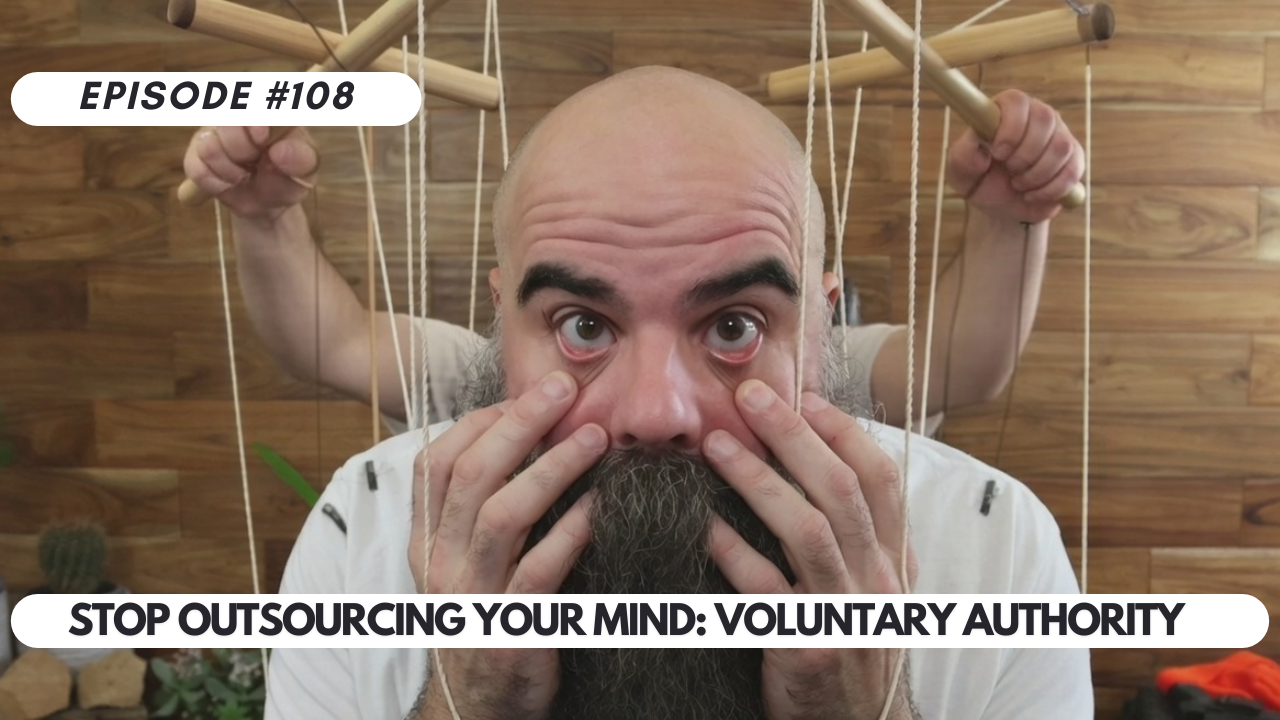
Episode #108 – Stop Outsourcing Your Mind: Voluntary Authority
Recorded December 16, 2025
Show Notes
In this episode, I talk about how authority can become harmful when it stops being a choice and starts being forced. I give examples from parenting, education, religion, work, and government to show why it is better to pass on responsibility instead of forcing it on others.
I introduce a framework built on the non-aggression principle, natural consequences, and moral cause and effect. I also explain moral ideas in a fresh way, saying that sin means missing the mark and repentance means making a change, not just giving in.
This episode combines personal reflection with simple philosophy. It is for anyone who feels unsure about how authority works but cannot quite explain why.
All Videos Hosted on Bitchute
BitChute is a peer-to-peer content-sharing platform and associated services. BitChute aims to put creators first and provide them with a service that helps them flourish and express their ideas freely.
Video chapters:
- 00:00:00 Why These Daily Philosophy Logs Exist
- 00:02:20 Why You Are Here and What This Channel Is Not
- 00:04:37 Childhood Hierarchy and Survival Dependence
- 00:05:56 Parenting by Responsibility, Not Control
- 00:08:28 Authority vs Authoritarianism Explained
- 00:09:40 Natural Law and Universal Consistency
- 00:13:40 Natural Consequences vs Enforced Obedience
- 00:16:08 Laws vs Rules and the Illusion of Control
- 00:17:30 Sin as Missing the Target
- 00:20:29 Anxiety, Awareness, and Mislabeling
- 00:21:56 Education, Intelligence, and Scripted Thinking
- 00:25:32 Narratives, Filters, and Social Conditioning
- 00:30:05 Depression as Structural Rebuild
- 00:35:09 Non-Aggression Principle and Isolation
- 00:38:48 Anarchy as Voluntary Order
- 00:41:51 Why Gurus Are a Trap
- 00:45:53 Trauma, Patience, and Rewiring Behavior
- 00:49:58 Gig Work, Choice, and Mental Autonomy
- 00:56:24 Closing Thoughts and What Comes Next
Note to Viewers:
As a speaker who explores unconventional viewpoints, I understand that not everyone may agree with my ideas. However, please share your thoughts and respectfully dialogue with me. Through these conversations, we can gain deeper insight into the world around us.
We appreciate you joining us on this enlightening exploration of societal complexities. Your [Support] means the world to us, and when you [Donate], it keeps the show going.
Supporting Our Decentralized Show:
It’s crucial to note that this entire show operates in a decentralized manner, made possible only by generous donations and viewer tithes. Your contributions are invaluable and empower us to continue delivering thought-provoking content.
If you want to support our mission, please visit our donation page. Your contributions significantly sustain our platform and enable us to bring you more engaging and insightful content.
Thanks for being an essential part of our community. Together, we are making a positive impact.
Warm regards,
Dave
Transscript
(00:03) silence. Okay, it is December 16th, 2025 at approximately 8:22 a.m. Uh, I like putting the the time and dates there. So, you know, when historians when the aliens land and they look back on the advancement of philosophy, they can pinpoint the exact time that these uh logs were created for mankind. Wow, my coffee is hot.
(00:37) Delicious, but hot. I’m going to try I didn’t set out to uh I guess I am setting out to because you are what you do make a video every day. I don’t know how long I’ll stick to it. It’s not like one of those things where like certain things in my life I’m like I make a choice I’m going to do this this and this.
(00:58) Other things are more casual. I have a lot of stuff going on right now that I’m working on and I want to prioritize this video because, you know, as we know, you are what you do. So, if I don’t do philosophy and I don’t do these videos, then I am I’m not progressing and I’m going to end up in the same spot that I’ve been, which is constantly trying to create these businesses that create this income that make me independent so that I can talk freely online without working worrying about finances.
(01:30) Uh, instead, I guess I just have to start recording and see where it comes up. I do I did do a video yesterday that I haven’t put up yet. I went through the transcripts this morning and I was like, you know what, while you’re fresh, I had a good night’s sleep. Let’s get on talk a little bit.
(01:49) And I wasn’t sure what I should talk about. But I guess one of the things is like um why should you even be here? Why why why should you even be here listening to me? Uh, I have another podcast that I do a live stream which is like a comedy stream and I kind of like joined over to that. It’s every Saturday night 10 p.m. Eastern Standard Time with Dalton Puit on Gordon F Daltton.
(02:20) But I came into his world, to his fan group, and I guess I’m not that charismatic or that likable or uh there is an age gap, but the fans seem to feel a little bit uncomfortable around me. Uh so obviously it’s not charisma. You’re not here because of my charisma. You’re here for some sort of knowledge, some sort of philosophy. So when you don’t have forced authoritarianism, so currently most of the system that we grow up in, and I touched on this in my last video, and if I remember, I’ll link it here, but go back. This is episode 108. I think this
(03:00) is episode 107. And if you go to my website, you can go on there into the search function and let’s do some let’s do some house clean. Everybody loves to start a show with somebody plugging a bunch of stuff, but if you want to get a deeper dive into what I’ve been up to, head over to my uh link tree which in which is in the uh description here and everything and you’ll be able to find me on all social media.
(03:29) You’ll find find me on X, Instagram. If you need to send me messages, I don’t really post that much um content. I do clips and stuff on some of them, but you can find me on Subscribe Star. This will be up on my website and stuff, but what what I wanted you to do is click on my website and if you want to see my backlog of stuff, you can just go right into the search bar and think about something that you would be interested in talking about like freedom of association and see if there’s anything I did on it.
(04:03) And these episodes have some talk about freedom of association. If you wanted to look about freedom of speech, these are two that talk about freedom of speech. So, you can get some stuff that was less edit that’s less edited. The the audio wasn’t that good. It was from my two crosscountry trips that I did where um I spent 45 days basically on the road traveling around America and just doing a a log for myself.
(04:32) But in the current state of of where we live, most of us are brought up into author authoritarianism of hierarchies. And uh from day one, you know, when you’re born, you have really no choice but to listen to the people that are in charge of you because without them, you will die. You need food, water, and shelter. until you can take care of that on your own.
(05:04) So, uh, when you’re first born as as a baby, you don’t quite get that because you’re trying. It’s all about your needs. So, you cry and you’re like, “Give me some food. I just took a shower. My eyes are my eyes. Is that creeping people out?” So, when you’re a baby, you cry to get me food, cry to get me sleep, cry to So, it’s like all about your needs of survival.
(05:31) And hopefully you have good good parents and grandparents and community around you that they recognize that and they do give you the attention that you need that you were begging for, literally crying out to survive. But as you get older and you have words and you’ve learned some knowledge or whatever, they expect you to take a little bit more responsibility.
(05:57) And I I would say the best way to to parent or to peaceful parent if I were to have a child is I would have a child and I would have 100% with with my wife 100% responsibility over this life form. But as soon as that life form, my child became to be able to be responsible for certain things, you’re going to slowly hand them responsibilities and see if they can handle them.
(06:26) they can’t, you take them back and then you keep handing them and then finally one day you just look up and they have they’ve taken all the responsibility into their hands and now you’re just guiding them. So when they have questions they come to you uh and you can answer them and walk them through to figure out what to problem solve.
(06:48) But if they just kind of look at you infinitely as a guru when they come up to an issue that they just ask you and you answer it, eventually you’re going to pass and they’re going to be alone. So the important part about that is that you have to have some sort of core principles that you bestow upon them. Morals, ethics, values, core principles, understandings.
(07:15) So there’s a framework and a system in play that works positively so that they can plug and play their life, right? And hopefully that’s a good system because someday you won’t be there. But also, you don’t want to be uh they don’t want to be dependent on you forever, right? Not that there’s anything wrong with voluntary dependency on on individuals.
(07:41) I think voluntary dependency can be good as long as there’s systems in play if something were to happen to one of those individuals that the other individual is taken care of because if you become fully independent on somebody and something happens then then you’re also in trouble. Right? So if you don’t teach those systems, it can be dangerous because they get into the world and you think they’re on their own, but they can start using that dependency, right, on authoritarianism to always look to the government for help, have the government pay their
(08:20) food, shelter, take care of their responsibilities and stuff like a like a child or another authoritarian person. I’m not saying that you can’t have like a hierarchy of needs, right? Or a hierarchy of people that you check with as long as it’s voluntary. So, let me explain this a little bit. Um, example would be if you’re going to go to a doctor or a dentist or a personal trainer, right? and you don’t know anything about the craft and you go in, you’re going to allow the personal trainer to be the authority on what you should do to get healthy, to
(09:02) lose weight, to diet, exercise, and stuff. And then if you listen to them and then you actually do what they say to do and you get positive results, you’ll say, “Okay, this person is an authority, right? not an authoritarian, although you might want them to yell at you or whatever. The difference being one of them is taking charge of you uh involuntarily, coercively using force, right? They tell you you have to do this and if you don’t do this, there’s a punishment.
(09:35) And if you’re always raised in that manner where do this, do that, do that, do this. If not, you’re punished by me as a person, right? then um you you you’re becoming authoritarian. Now, let’s get into religion. Everybody loves to talk religion a little bit. I’ve been talking some politics. So if you do think there is um a wrong and a right, a good and a bad, morals, ethics and values woven into the fabric, right, of society.
(10:15) And you believe that there’s science right that um you know gravity is at least as we know and understand it around the earth’s pole you know things are getting uh pulled toward the earth constantly at 9.8 m/s squared and if you don’t have a force stopping you like stepping on the ground or whatever you’re going to go until that force stops you.
(10:42) you can you you remain in motion until you hit something else that can stop you that has force in the other direction. Those don’t have to be in contradiction to thinking that there is some sort of and I don’t want to say like a higher being. People like often hear God and they think, “Oh, there’s a man on a cloud with a beard and you know, he’s he’s pointing at people and throwing lightning bolts or whatever.
(11:13) ” But if I can just from a pure like um just open your mind with us for a second, right? And imagine that, you know, the I if you’re on on Earth here and you drop this, it falls, right? And let’s go way out into outer space, million miles away. We find another similarsized planet and you go there and you drop that.
(11:48) You believe that it falls, right? You believe that universally gravity for what we know it as is going to exist everywhere. If 1 + 1 equals 2 here, 1 plus 1 = 2 in Minnesota, 1 + 2, 1 plus 1 equals 2 in Japan, 1 + 1 = 2 on the moon, and 1 plus 1 equals 2 anywhere in the universe. The words could change. It might be like zak plus zak equals zuk lock, you know, but like the the the idea of having a unit a second unit and this is two units stays universalized, right? And you can have faith that when you wake up that that’s going to be the same.
(12:35) Then there is something that holds that together universally, right? for for the discussions here. Let’s let’s name that thing God. Okay? Let’s let’s name that universal principle that we know that it exists and you can keep asking why why why why and you get deeper and deeper and deeper and deeper. But there’ll always be another why.
(13:08) And if you just pin that point with the fact that there is some sort of force in the universe that keeps things consistent and organized very specifically, then that is an actual consequence, right? So if I were to jump off a building, I would fall. If the building was high enough, I could perish. if the building’s at a certain height, you know, depending on that I might break a leg depending on the density of my bones and stuff.
(13:41) Whereas maybe I just fall and tumble and roll and I and I’m fine, right? So, you can teach somebody, hey, falling from that distance is going to hurt you. But if they get on top of that building and they’re like, I’m not going to jump. I just want to maybe they to see the view and you’re like, “No, get down.” And you point a gun at them, you could fall and hurt yourself.
(14:02) Get your get down. I’m going to put you in a cage. It’s like there is already a natural consequence built in. Falling off that building and dying and getting hurt as a consequence. You don’t need to use uh like you know authoritarian power to stop or prevent things that may or may not happen. This is a like a control freak um type experiment where the individual loses the individual in in that situation that’s on you know I’m picturing the shed I grew up and I had this like small shed in my backyard it was maybe like 8t tall maybe six feet at
(14:41) the back because we used to be able to grab it maybe four or five feet on a slope maybe eight feet at the top maybe maybe seven and it was way in the back by the garden and I remember a couple sun Sundays in in weekends in my or maybe during the summer as I got into my teens that me and my buddies were taking like a tarp and putting rope on it and I’m like we’re going to jump off the shed and see if we can like catch enough air to slow us down and trying these experiment. Luckily we never got hurt.
(15:14) Um, but we were testing some scientific experiments with like uh boards and uh uh uh tarps and stuff uh stuff like that. We we never ended up getting hurt, but there was a natural uh understanding that jumping off of that would make you fall to the ground. We luckily never got hurt. Uh we did kind of keep it from my parents because they would say, “Please don’t do that.
(15:40) You’re going to get hurt.” Uh, but there was a not whether my parents showed up and told me like whether or not my parents would show up and tell me not to jump off the shed, the consequence was still there, right? It’s still built in no matter what. So, it’s a law of the universe. Often we hear, this is a distinction I like to make between laws and rules.
(16:04) Like a government and a man cannot create a law. They can create a rule for you to follow. And by man, I mean mankind, woman, person, an individual with a gun attempting to to get you to do something else. They can create a rule for you to follow, but and then they can give you consequences, but they’re just being authoritarian, right? They’re just saying that I know better than you and uh I’m in charge of you and I’m going to punish you if you don’t follow these, you know, these consequences that I’ve created. But there is already natural
(16:38) consequences in place, right? There’s already natural consequences that happen within the the universe. And um so anyways to go back to the beginning here the importance of having some sort of framework as a child is to or or up to an adult is so you can look at your surroundings right and find in the beginning the natural consequences of say jumping off the shed right but then as things become more complex you want to start seeing there’s this there’s this underlying fabric that’s woven in um that’s morals, ethics, and values that
(17:31) also have consequences, right? That also have long-term consequences that can bother you and affect your life. And you you want a system to also figure that out, right? So, it’s not going to be as clear as jumping and following and break and and breaking your leg. It might be um you know uh poor poor life decisions, poor relationship, friendships, uh what have you, right? And if and when you think about something like the Bible, people often hear like uh a sin, right? And and they’re they’re proud to sin.
(18:14) They’re proud. They’re proud to sin. That’s funny to say to me because pride is a sin. So, it’s a double sin. Not only are they’re sinning, but they’re proud that they’re that they’re being they’re sinning. And if you go back and just think of the word sin and and just, you know, clear your mind of everything you’ve been told about the word sin and recognize that sin is uh missing the target, right? So, say you have a a a moral target that you want to hit and here’s your arrow and it’s going right towards the camera,
(18:56) right? Oh, that’s a pretty cool focus move. So, you got that ammo and it misses and it misses and it misses, right? You want to fix that. And if you were shooting the actual arrow, you’re going to start making course corrections. But when it’s morality or whatever, you you it may have caused other problems that you have to fix and then get yourself back on course.
(19:27) So you sin, which is to miss the target, and then you repent, which is to get back on target. And how long that repentance takes is based on a lot of factors, too. So if you fall off the sh, you know, you jump off the shed and you break your foot, you have to now repent for the sin, the falling off track. And if you take it seriously and you rest and you rehab and you eat correctly and you hydrate correctly and you get the right amount of calcium and you get the bone structured and held in place, it’s going to be a fast recovery. You’re going to
(20:02) repent and get back on track of being able to run, jump, play, and swim quicker. Then if you don’t take it seriously, you walk on it. You don’t eat right. You don’t rest. You don’t recover. you don’t get the minerals and nutrients that you need, you don’t reset it. It’s gonna stay mangled, stay hurt, and stay injured.
(20:27) Right? So, these are that’s an easier example to see because the pain is immediate immediate and you know where the pain’s coming from. in life it gets a little bit messier because you people start getting depression uh anxiety mental illness and um and even those words get framed in that way right uh based on the people that are teaching you stuff so they’re like oh I’m anxious and it’s like are you anxious or are you self-aware that there’s danger you know what I mean anxious implies that there’s no reason for you to feel like this and you are wrong and you’re
(21:03) doing something bad, it needs to be corrected. But self-aware, hyper self-aware of your surroundings is a good positive thing that keeps you protected. Um, I I won’t get off on track with that because I’m already feel like this might be a little bit difficult of a a path for for people to follow, right? Um, so back to myself now, right? So I was going through my childhood and um in my adolescence and I both adulthood and then in my 20s I was I was I was always on the cusp in high school of like troublemaker but I
(21:49) was getting good grades so people didn’t know what to do with me. I was getting A’s and causing trouble. And so they’re like, typically somebody’s getting Fs and causing trouble, but he’s causing trouble and getting A’s. So they’re like, I don’t know what to do with them. And by the time I got out of high school and I got into college, I was so frustrated because I’m like, I just got A’s and all this stuff.
(22:13) You guys don’t even have courses. Like, I already did these courses. You’re making me do them again and pay for them. And no one’s listening to me, and I’m getting A’s again, but I’m not even trying. So, I’m not even being challenged. And then if I try to talk to anybody, you start recognizing, oh, these people aren’t that intelligent.
(22:33) They have these books that they’re just following along. There’s an authority above them. They’re like, look, we gave you a piece of paper and written on this piece of paper gives you power. And then we’ll give you these books and then then you learn these books, but you don’t learn the subject. You don’t learn the the the cause and effects and the understanding, the intricacies.
(22:54) You’re just mimicking what’s in this book because we gave you this paper piece of paper because you went through this process prior. And they create a a system for you, like a track that goes on. So, I’m I’m I’m in high school and I’m starting to recognize it. I get into out of high school into college and I’m really recognizing it.
(23:18) So, I get out of out of college. I drop out and now I’m looking around and I’m just recognizing that so much of what I’m seeing is not what I’ve been told. And everybody that I go to is pretty much like, “Oh, you need therapy. We need to get you on drugs. This is, you know, you’re not understanding. You’re you’re jumping to conclusions.
(23:42) ” And and I was I was like I I don’t know. I I don’t think I need drugs. It’s like I’m doing fine. You guys aren’t answering my questions, right? I’m asking you a direct question like why is this this and this? And your answer is don’t worry about that. You need drugs. So luckily, as bad as some of my childhood was, my mother was really good because originally when I was in school, I was extremely bored and anxious and jumping all over the place and they kept saying, “He needs riddling. He needs riddling.
(24:17) He’s hyperactive. He needs riddling.” She refused to do it. Then I went, we switched schools. When I got to the new school, um they said we’re going to test them because we’re going to put him in the mentally challenged class and we wouldn’t know which specialist we should pull in. And then I did the test that they had there and they said, “Oh, actually we’re going to put him in this academically talented class.
(24:41) ” And then I did much better once I get into that class. I met some friends. We were actually doing like challenging stuff in in math or whatever. And the teacher was cool and she was fluent. You could actually ask her questions and she would respond. Mrs. Riley, shout out Mrs. Riley. She’s like one of the few teachers and Mr. Hall, my art teacher.
(24:59) You could ask them questions philosophically and they would have answers for you. They weren’t like scripted. But as I was getting out into the world and I was starting to see stuff and I was starting to ask questions, um Tony Robbins talks about this is when your mental goals and understanding don’t match reality, you can either bend your mind to reality or bend your mind to like the illusion that you’ve been told.
(25:31) And you know, I really hate to say it, but this is like the whole idea of of uh the matrix, right? In how to na circumn the matrix as you walk around. But the reason the word that word has gotten so much things is because everybody knows something’s going on, but they needed a word to help you understand it.
(25:55) But this is not something new that’s been happening, right? Uh like back in the day when there was, you know, before like the printing press, right? The people that were in charge would shape a narrative. They would read the holy scriptures and they would tell you what to do and you had to trust them.
(26:16) But they’re creating a narrative like where the people that can read, we’re the people with the stuff. You guys are like below us. Then the printing press comes out and like here’s the book for everybody. You can read all these books and knowledge and starts things start getting mixed up and then you know wars and people are fighting because they want to be in control of this path or this information and it’s kind of off setting stuff.
(26:41) So like nowadays people like oh women use like these filters online and there’s like AI online but prior to that women were still wearing makeup or even a veil even the idea of a veil that you can see through is like a filter. You know what I mean? And um the old school days when they used to wear the heavy dresses with the the corsets that make their waist thinner and then like wire things that that made it puffy passed out to give them a shape.
(27:12) There’s always a uh like a reality like you can put something on a scale, measure the details of it. Then there’s a social element of how people move within society. Um and then norms happen and the norms are what most people accept that they feel comfortable with and outside of those norms these fringe areas are the things that people don’t fully fully understand right um one example I guess would be there is would be a time in history where this beard would be the norm right or in certain parts of the world this would be the
(27:54) norm or certain parts of like countries in certain times, but nor now it’s clean shaven. So when people see me a lot of times they have a lot of questions. They wonder why. Oh, why don’t you shave the mustache? Why don’t you do this? Why? And what they’re what they’re saying is I’m comfortable with seeing a A, B, and C. This is X, Y, and Z.
(28:14) And I’m not saying like I’m this perfect uh being that lacks any vanity or whatever. What I can tell you is when I shave the beard, I don’t feel like myself and I don’t enjoy it. Other people love it. Women enjoy it. Uh, you know, people feel comfortable when I’m around. When I have the beard, people feel uncomfortable.
(28:39) Strange women will come up to me and shave it and tell me I’m ugly. Um, so if you’re the type of person that has a lot of social pressure, you would you would follow that. For me, this is what I feel my most self. I don’t even really recognize the beard. I notice it here because I’m talking to a camera, but I actually have a monitor here that’s showing me what I’m seeing.
(29:00) So, I’m seeing the beard and recognizing it. But to me, this is just another extension of myself that’s being um put put out put out there. So, um where am I going with all this? the these these these rants, right? What what I think I’m going to do is I’m going to do like these rants. I’m 30 minutes in here talking about these different different subjects of society.
(29:28) And I’m sure that there’s some pieces that I started some branches that went off and then I stopped and then another one went off and I stopped and you’re like, I wanted to hear more about that. Well, that’s what I want to try to do, right? is have you take those whatever those branches were that you liked and comment those below, let me know and I’ll start making videos, detailed videos like step by step walking you through the thought process of those ideas and this will be a back and forth between between the the the two of us.
(30:03) So let’s see some of the topics that I discussed now like handing responsibility over to kids uh removing authoritarian uh my my thought process up till now. So all right so let’s let’s continue about me. So I get into my 20s and I almost have or I do have a very difficult depression and breakdown. Um, I wouldn’t call it me mental illness, right? Other people would.
(30:36) It’s like a restructuring, right? So, imagine you um you build a house, right? And you’re it’s your first house that you’re building and as you build it, you’re going to other people and you’re saying, “Hey, how how do I build this foundation or what, you know, look at this field here?” here. And somebody’s like, “Oh, it would be really nice if the house was over there.
(31:02) It would look good to look at the mountains.” I was like, “Oh, I’ll start building over there.” And how do you build a foundation? Like, oh, what I would do is I would just put some um, you know, cement down there or whatever. And yeah, yeah. And I like three stories. And you’re just like kind of building this house in these layers of your life that go up.
(31:20) But then as you get older, you’re like, “Wait a minute. My foundation was built over here because this person told me it looked nice. But this is like sand and the foundation’s trying to start like sinking in. I probably should have surveyed the land here, figured out what was solid and where there was a strong foundation to build or backfilled that or whatever.
(31:45) And I would have liked the basement um because I can store stuff down there and I can put my uh uh major house appliances down there and so but I didn’t make one cuz somebody told me to do it this way. And then I built three stories straight up. Uh but now it’s there’s a lot of stairs that I don’t like.
(32:06) I do have more windows and it’s like well I want to rebuild this but like the whole thing’s like kind of broken. It’s not where I want to be. And so I have to like tear this whole thing down to to the bones and say, “Okay, this lumber is still good, so let me store the lumber over here. These ideas aren’t bad. This flooring’s not bad.
(32:28) The sheetrock’s destroyed because you can’t reuse it. This is this, this, this, and this. And let me rebuild everything and and and and go through my ideas, right? and figure out what’s correct, what’s false. Not from outside influence, but from well, everything’s outside influence, but not from being told what’s right and wrong or what’s good or bad, but actually going through and doing the work and seeing the incentives that are set up.
(33:00) uh you know like like um the meat industry is not going to be pushing veganism anytime soon and the industrial war complex is not going to be pushing uh uh peace anytime soon and abortion clinics aren’t going to be pushing pro-life anytime soon. There’s incentives that people build into their to their lifestyle. And when I when I decided to go break everything down and build from the way up, um I had a choice cuz I was starting to like just say [ ] it. (33:36) But I was like, “No, I don’t want to say [ ] it. I want to freaking tear it all down and build it all back up.” I see people do this sometimes where they do partials and they try to refix what they’re doing. And you can survive that way, too. Because imagine like my life wasn’t going great at the time. it’s going pretty bad.
(33:55) So if you built a really good life on atheism for example or Christianity and then you start questioning that well your family your community your life your job everybody you surround you with is built you you’ve built this life on that and pulling that rug out you may lose and and and crumble all that. So some people make the conscious decision that I’m just going to stick with this even though I felt like I made some mistakes because it affects too many other individuals.
(34:28) And then the next generation gets born into these um these points that have been conceded because it’s easier and they build off of of those ideas. And and I was like, you know what? I’m going to bring it way back and try to rebuild my whole structure and then teach people how to rebuild their restru uh their life how how they want on core on core principles.
(34:55) Um, so anyways, I tear myself down basically to the bottom and I start figuring out some core principles and one of them was the non-aggression principle which I had kind of known already. When I first got into thinking about this stuff, I felt so alone. I remember just talking and talking and talking to people about like I don’t think we should be using force and the government is stealing money from us and they’re throwing us in cages and people are like oh Dave is losing his mind like he needs like um he needs to go to a mental institute and
(35:35) all this stuff and they did they tried to put me into homes and stuff. Um, I finally finally I was on the on on the intronets and I and I used to watch John Stewart and it would get my blood boiling back when um it was like shooting shouting into a void like he was making these proclamations on TV and everybody either would just laugh at them and ignore them or believe that they were real and if you tried to like fight any arguments of it, everybody thought you were the crazy one cuz he’s on TV. He’s articulate, you know, he’s
(36:11) got a full head of hair. Uh, who are you compared to him? At the time, I think I did have hair, uh, and no beard. And then I was on the internet one day and I was looking at a John Stewart video and this guy Stefon Molyneu came on and he started talking about these ideas and and tearing down John Stewart’s thing.
(36:33) And I was like, “Yes, this I’m not I’m not crazy. There is I mean I I I probably should have been able to find it sooner with books, but um I didn’t start reading till late in life because the teachers had just beat reading out of my mind. They had absolutely beat reading out of my mind.” Um because they like you know they’re like you’re going to read the Scarlet Lever and Little Women and I was like all these boring books from these female educators and then it’s because they know these books and they like these
(37:13) books and day year in and year out they have people read the same books and get the same stories and talk about the same thing because it’s not any thought process, right? You would think they would want you to read a book that you like and then tell them about it, but then they can’t check you, right? And it’s about your grades and your thing.
(37:32) It’s not about you enjoying yourself or even figuring out a strategy to trick a teacher. I mean, at least that’s a skill compared to mimicking these books that they like. So, I didn’t read I haven’t read Mises or uh Rothborg or any of these people. Um, I prefer more efficiency stuff in my life.
(37:58) I read a lot of James um, Stephen Presfield and stuff, but I’m not a big reader. I like to learn by sitting and thinking and then going and checking the data after the fact and seeing if I can figure this stuff out on my own. But anyways, I found this guy Stefon Molyneu on the internet. I think it was 2005 2006. made this video combating John Stewart’s thoughts on libertarianism.
(38:26) And this I had heard the term libertarianism like in the background. Uh but I was in the punk scene. So I was just talking about anarchy with everybody and they were like, “Yeah, anarchy, like smoke cigarettes, get tattoos, whatever.” And I wasn’t doing drugs. I don’t have any tattoos or whatever. was in the punk scene and they were uh against authoritarianism and all this stuff.
(38:52) So I really thought that I had found this this group that understood anarchy was um anarchists and this is going to sound pretentious and I don’t know exactly how pron I’m first generation American half Greek halfRussian part German but it was basically on which is without and raas is like rules or ruler so it roughly translates to rules without rulers which is not chaos right It’s organiz It’s perfectly spontaneous organi or organized um spontaneous voluntary organization between individuals.
(39:32) So we we have rules. We’ll set rules up organically. They can stop and start when we need them to. Like when you walk into um the personal trainer, they’re immediately an authoritarian towards you. Voluntarily the authority, not authoritarian, the authority. and as soon as it’s over, you leave. But they don’t tell you how to drive your car or pay your bills or vote or or do any of these things in your life, right? They’re strictly like, you know, you’re paying them for food training, how do I lift weights? What’s the structure? How do I stand? Where do I
(40:06) bend my knees? How do I put my shoulders back? How do I stretch? Right? And so it’s it’s a fluent give give and take um between stuff. you know, you walk into uh a grocery store and then that person becomes the the temporary authority if you have a question about where something’s located because they know the building.
(40:29) But when you walk back out, you don’t get on your phone and say, “Hey, uh Gus, how do I get to the gas station?” Right? because that it’s it’s a fluid work between giving the the power back and forth based on uh the individual’s experiences and uh what they know about. So, uh I was like, “Okay, so I’m not crazy. I’m just like an outcast.
(40:56) I’m on the outside of this thing. So, let me start researching it a little bit more because and I started building these pieces up and building these pieces up and talking to people and then going to these events. But even when I would go to the events and try to explain some of these stuff to people that claim to be like a libertarian, you’re like, “Oh, we we completely disagree too.
(41:22) ” You have also like read a book. And so you you’re just reading a book and then regurgitating what you learned in that book and because you liked it and you didn’t like this system so you’re like what’s the other system and I’ll so I you know so basically for lack of a better word it seems like everybody’s looking for some sort of god or some sort of guru to give them the answers.
(41:48) And as time went on and I, you know, I formed some groups and stuff and I started talking to people. People did like what I was saying, but then I didn’t like doing it because they were treating me like a guru or a person with all the answers. And it’s like, no, no, no. The It’s like I I used to have this thing when I did Facebook.
(42:08) I had this big Facebook account before it got banned. And I used to do Sunday punday. And one of them was a picture of a dolphin or a short-nosed like beluga whale or something and it said um if I told you what anarchy was that would defeat the purpose instead of defeat the purpose. And uh and the idea was like you have a core principle right that the initiation of violence not in defense the initiation of violence is bad and once you have this core principle and you look forward into the world and you come across a problem
(42:56) you have to you don’t have to do anything. I would suggest that you then look at it and say, “Okay, I have this problem. How do I solve it? Through negotiation and peace, right? How do I solve this problem through negotiation and peace?” And most people give up. They get frustrated or they don’t care about that and they resort to force and violence, right? And they don’t even recognize it.
(43:24) It’s be violence is so uh common and normalized within the globe in the society not everywhere but most places that people don’t even recognize that there’s a violence right and even in very peaceful places without crime sometimes is the most violence you know if you look at places it’s just h it’s just hidden if you look at places like Japan and China or not China maybe a bad example But like um uh Japan, Switzerland, and Sweden where they say, “Oh, we don’t have, you know, we don’t have a lot of crime and it’s common, but
(44:03) the people have been kind of like subdued into a point where they pay these high taxes. The government’s still printing money and they have to stay in line. If they step out of line, there’s huge consequences inflicted on them by the the powers that be. It’s not internalized uh um understanding.
(44:27) It’s internalized fear that has made them meek, right? Has made them internalize these ideas uh to a point where certain countries like North Korea no longer and we we recognize the violence there, right? But they don’t even have words like liberty, freedom and stuff because um then you can’t conceptualize them, right? So if you take the word away, you ban the word, then that thing does almost doesn’t even exist anymore, right? Um, so where was I going through this? So I’ve built the house.
(45:03) I’ve gone through I start doing the work. And then you get on the other side and you’re like, “Oh, now I’m fixed. I’ll be able to find a wife and have kids and a family.” And then you go out and you’re like, “Oh, well, I recognized that I’m even further away, right, than from everybody.” At least when I was broken, I was running to other broken people that I could be broken with.
(45:24) Not that I’m fixed. It’s like an ongoing process. And I have a a lot of ups and downs. Uh it’s it’s a you know, it’s a system when something goes wrong. Like yesterday, I was out shopping and I’m in the middle of the store and I had got like the last pint of blueberries that they had and they were in my basket and I I went to put something in the basket, but I didn’t want to crush it and I got them first from the produce.
(45:51) So, I pulled them out and the back part of it wasn’t snapped. So, all my blueberries just went all over all over the basket. And then I was like, I guess I’m just going to sit here and pick them up. So, I had to like take everything out of the basket. I’m just sitting in the aisle, grown man, and I’m just slowly picking blueberries and putting them back into the the pipe thing.
(46:12) And what was interesting for me in that moment is I remember for my childhood having trauma like anytime I made a mistake spilling milk literally like we didn’t cry over spilled milk in my house. You got beat over spilled milk in my house. It was like so reactionary and like punished oriented.
(46:34) You’re just like living under this totalitarian rule within the household where you can’t make a mistake. And so then I would I went out into the world panic struck in with fear of making an error this weird perfection uh complex. So, I spelt spilt these blueberries and I’m just sitting there like giggling and like picking them up in the middle of the aisle like I’m stoned or something and I probably look like a pthead to to the outsiders.
(47:02) Um, and I felt like when I felt like the the a little bit of the embarrassment kick up, which used to like uptick and extreme make me panic in the past. I felt it start and then like it turned into laughter like I’ve my brain has been reprogrammed through these training sessions and like philosophy and stuff that I’ve been doing over the year that I just sat there very patiently even my patience right I was picking these up and in my head I was saying like patience is not something that you get it’s not an end journey right
(47:42) patience is a practice and so as I’m sitting there and I’m picking the blueberries up and And I’m on a time frame. I had to be somewhere at 4:30 and it’s like 4:15 and my blueberry spilled. I could panic, but it’s like panicking is not going to get me to my appointment and my checkout any quicker.
(48:00) I’m here is my issue right here. Here’s where where I am. And what ended up happening too is my appointment was late and didn’t get there till 5. So had I worried and rushed or whatever would have been for nothing anyways. So, I pick up these blueberries and in my mind I’m thinking patience is a practice and I’m practicing patience.
(48:20) I say that five times fast. And that I I do look back and say that is because of the work that I’ve done. And I don’t see it all that often anymore because I’m up in New Hampshire, but I do see and when I go down to the city, I see it a lot more, but I don’t see it up here where I live. his parents being very short and snappy.
(48:43) I’ve seen I’ve seen people behind a counter be snappy with people like cashiers and stuff. And I’ve even called it out and then this is a whole different story. And then people got mad at me for calling out people for being rude to one another. And I see it with kids and stuff. And I think like, you know, this is it’s clear to me that somebody has not stopped, right? And I talked about this in the last video too is like everybody with the inflation and the economy and the and the rise of food and housing and
(49:17) stuff, it’s become so difficult for everybody to there’s no time. We’re still running from these imaginary lions and tigers and bears. Uh, I know you said it in in your head and and then the there’s no P. We need a pause. We need a break. There is something you can do, right? You you can’t you you can’t just change where you’re at.
(49:50) You can like tomorrow morning you can wake up and just do everything different, make a new decision, things will change. But the the thing that has to change first is the mindset and the understanding. And you can do that anywhere, right? So, if you’re stuck in a job, right, let’s I’m going to try to spend this last 10 minutes here, how you can utilize some of this stuff.
(50:13) And as we go on, like I said, this will create questions for you hopefully. And if if you do have a question, put it put it below or email me or DM me on one of my social media sites if you want it to be private. Um, but what you can do, say you’re stuck in a job as a cashier, you’re stuck in a job as a Uber driver, you’re stuck in a job as a Door Dash person or whatever, you you h you can still think.
(50:43) They can’t take the thought process away from you. You get so like as an Uber driver, for example, I used to drive Uber during the pandemic. I did Lift. I do Instacart. I still do Instacart on occasion. I’m trapped in the house all the time in the winter. So, I did a Instacart shop yesterday. Got out of the house, got some, you know, did some shopping or whatever, dropped somebody’s blueberries.
(51:06) Um, I did some hiking, you know, got to get get out of the house up here. But when I used to do Uber in um Lyft or whatever in between rides you have a lot of time. So I would listen to training stuff on Amazon and I started doing an Amazon business which I still run today where I sell stuff on Amazon marketplace.
(51:35) Uh but it doesn’t even need to be that. You could, you know, you have time to watch and learn videos, but you could have time to sit with yourself and say, “Okay, like today I’m just going to try to re rewire things to practice patience. Every day I come to work and I’m so frustrated when I leave because people are so slow and they’re so dumb and they don’t understand.
(52:00) ” like you’re you you’re breathing that negativity into your environment and then when you come home you’re going to be so exhausted you’re not going to want to do anything because you want to try to shed that that negativity and anxiety, right? Hopefully you don’t bring it home with you, but a lot of us do. you you can say, “Okay, tomorrow I’m going to try to figure out some strategies where I can be nicer, kinder, more patient, not upset, not judgmental.
(52:35) ” And this isn’t that you like sometimes when you’re in a situation and you recognize enough patterns um because you’re you’re involving with you’re you’re involved with society at that point if you’re like okay like I’m surrounded by evil mean rude people I need to figure out a way to no longer be surrounded by evil mean you know Um, one one example for me, just one example for me is I I literally moved two hours north, right? I had a great great group of friends down there that I liked, that I grew up with, but I just hated the city.
(53:16) I hated the town. I hated the politics and the everything getting built up and I was I was trying to constantly get to the woods and stuff. And so one day I said, I just need to move towards the woods. And I just figured it out. It took me like six months of like planning and pulling things apart.
(53:34) And I sold a bunch of stuff uh over that six-month period of time. And then I kept trying to like get up here and look at places to live. And then I, you know, I finally just did it. And just that move alone put me in a a whole different different space, right? And when I first moved up here, I was doing I had my real estate inspection company, which I was doing, and I was doing some Amazon stuff.
(54:02) Um, but I was also driving around and I was like, “All right, I’m I’m going to try to do some of these other things that I did like Uber and Lift down there.” The people were friendlier. The people were kinder. And a lot of times when I drove um Uber and Lift, I would end up in the cities and stuff because that’s where all the people were.
(54:23) But if you just drive like an hour to the north, right, if you had an Uber drive and you got people that were you might, you know what I mean? You’re you’re like, well, the city’s got all the money. It’s like, well, I made equal money being in the country countryside just kind of learning the country. took a little bit of where to go and what but the people were nicer and kinder and by the end of the night I felt better and safer and whatever.
(54:45) So that extra hour drive was worth it to me. Um instead of just letting the app take me where you go this, you know, you can get on the app. I know this is going to sound like I’m all over the place, but it’s kind of like life. If you’ve ever driven any of these things, you can just take every order and go every place it tells you to, and you don’t know where you’re going to end up.
(55:07) And a lot of times it brings you to the worst, most stressful trafficfilled area ever. Or you can be selective and you say, “Okay, I’m going to drive, but I’m only going to take places here, here, this, and by the end of the night, maybe I work an extra hour, but I have five hours more of life and energy in me because I made good uh decisions and uh a good cho good choices.
(55:32) You’re you’re the steward of yourself now, right? And you have to be a good steward for yourself in order to then be good stewards for your your your animals, your pets, uh your neighbors, your children, your wife, whatever, your friends, whoever you’re putting your community uh in. So, I don’t know what to say.
(55:55) I don’t know what to say. So, I think I’m done. I feel like I’ve been rambling. um some of these points when some places and other I’m going to go through the transcript afterwards. Uh I I I don’t want to be scripted. I don’t want to be edited. I don’t want to use music. Um I do have some very large topics that I’ve discussed in the past that I can do very linear linear.
(56:22) Um but none of them really sparking me lately. The the Damon is not whispering in my ear. the muse is not coming in with her white dress with her gliding over the floor. When that happens, I will I will uh do that. So, if you could help me out though, I’m trying to build the channel.
(56:39) I guess my goal is to get 500 YouTube subscribers. So, if you’re seeing this, if you could please and you made it this far, then I know you like what you’re watching. So that the if you could just follow me here on YouTube or Rumble or Bitshoot, whichever best for you, go over to my website and check out some videos.
(57:00) Um, that would be really helpful. Let me just So it’s like, you know, it’s the the link tree is below. It’s Dave Wright the thinker. I have the website. I have a subscribe star. Uh, it’s free to subscribe. Uh, that’s where I’m going to put all the links to everything there. and kind of the community as a build.
(57:20) It’s not built yet, but I want it to be built. Um, donations, you don’t have to worry about this stuff now, but if you if you like prefer Rumble, follow me over on Rumble Bitshoot. Eventually, I’m going to not be so censored. I’m just going to make these videos, say everything that I want to say, put them on Bitshoot and Rumble, and then edit one for YouTube.
(57:43) Uh, if you want to hang out and ask me questions every Saturday night live, you can meet me and Dan Puit on Cornfed with Dalton Puit on YouTube. We go from about 10 p.m. Eastern Standard Time to sometimes we do 3, four, 5:00 a.m. in the morning. Um, typically we do 3 to 5 hours, sometimes with a guest, sometimes a solo.
(58:05) And yeah, that’s it. So, thank you for staying this long. And please comment below and let me know what I should talk about next.