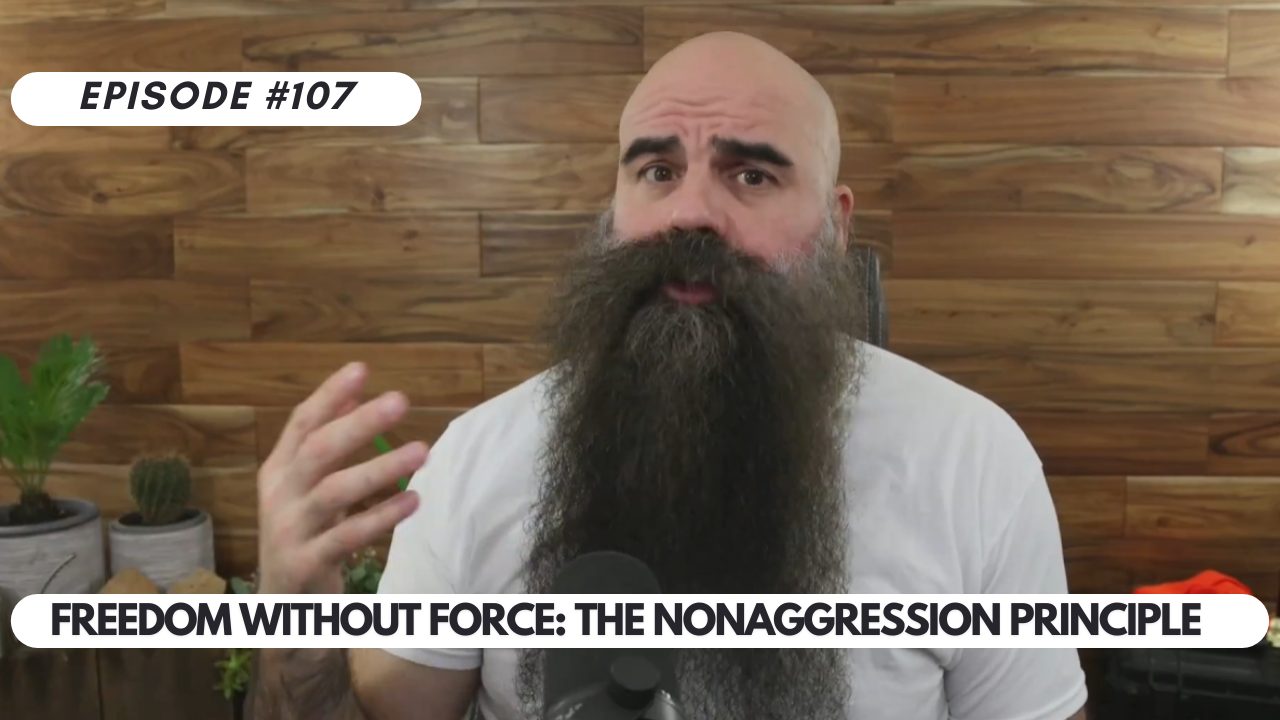
Episode #107 – Freedom Without Force: The Nonaggression Principle
Recorded December 15, 2025
Show Notes
In this episode, I talk about why I keep coming back to libertarian ideas, not because of political drama, but because of their strong ethical foundation. I explain the nonaggression principle in simple terms and show how it matters most when raising kids. If we raise children with fear and punishment, they learn to accept authority without thinking. But if we teach them negotiation, consent, and fundamental skills, we help them grow into adults who choose peace instead of force.
I also connect these ideas to what everyone is watching right now, like the buzz around the Nick Fuentes and Piers Morgan interview and the bigger issue of online speech policing. These are the places where debates, censorship, and fights over who controls the story are happening today.
All Videos Hosted on Bitchute
BitChute is a peer-to-peer content-sharing platform and associated services. BitChute aims to put creators first and provide them with a service that helps them flourish and express their ideas freely.
Video chapters:
- 00:00:00 Welcome Back and The “Muse” Problem
- 00:02:10 Why I Struggle to Pick a Starting Point
- 00:03:15 Emotion-Run Society and Reaction Culture
- 00:05:40 Using AI and News to Find Topics
- 00:07:40 Negativity and The Overton Window Shift
- 00:10:05 Pro Values vs Anti Labels and “Phobia” Framing
- 00:12:05 Libertarianism and The Nonaggression Principle
- 00:13:55 Peaceful Parenting vs Pro-Force Thinking
- 00:16:30 Negotiation as the Adult Alternative to Violence
- 00:19:20 Censorship as Force and “Argument Failure”
- 00:21:00 Freedom of Association and The Right to Walk Away
- 00:23:45 Slavery Spectrum and Hidden Coercion
- 00:31:40 The Uber Driver Clip and System Pressure
- 00:38:40 Why Philosophy Is Hard and The “Red Pill” Cost
- 00:42:10 Community Ask, Live Streams, and Where to Follow
- 00:44:20 15-Minute Reflection Exercise on Coercion
- 00:46:30 Borders, Property, and Vetting in a Free Society
- 00:53:30 Subsidies, Forced Demand, and The WNBA Example
- 00:55:10 Censorship, Financial Stability, and Decentralization
- 00:58:00 Final Ask: Questions, Topics, and Next Steps
Note to Viewers:
As a speaker who explores unconventional viewpoints, I understand that not everyone may agree with my ideas. However, please share your thoughts and respectfully dialogue with me. Through these conversations, we can gain deeper insight into the world around us.
We appreciate you joining us on this enlightening exploration of societal complexities. Your [Support] means the world to us, and when you [Donate], it keeps the show going.
Supporting Our Decentralized Show:
It’s crucial to note that this entire show operates in a decentralized manner, made possible only by generous donations and viewer tithes. Your contributions are invaluable and empower us to continue delivering thought-provoking content.
If you want to support our mission, please visit our donation page. Your contributions significantly sustain our platform and enable us to bring you more engaging and insightful content.
Thanks for being an essential part of our community. Together, we are making a positive impact.
Warm regards,
Dave
Transscript
(00:02) Welcome back. Welcome back to me laughing at myself as this start. It is uh December 15th, 2025. I’m recording this at like 11:36 a.m. And um I don’t know. I I I need to just I’ve mentioned this before. When I first had the idea that I wanted to start a philosophy show, I had a daemon just sitting on my shoulder whispering in my ear nonstop 247 365.
(00:40) It was interfering with my sleep and it’s like you have to create, you have to get this information out. And um just having discussions with people in real life over the years on the internet um I wouldn’t say that I’m beat down. I personally individually feel better than ever. um not quite as good as when you’re like emotionally asleep and you’re still like in the matrix and you’re in your your early 20s, late teens, early 20s.
(01:18) You’re full of energy. You have a six-pack without even trying. Uh and you’re kind of like unaware of everything that’s going on, but and then you wake up, you know, you have this realization what the the world’s really like. Um, since that has happened, I’m feeling pretty good. Uh, I’m relaxed. I’m calm. I’m sleeping well.
(01:40) Uh, I’ve quit quick caffeine. So, I haven’t been on caffeine. I did have some I had like a couple of tablespoons of uh some preworkout over the past month and a half, almost 45 days now. uh when I was just like so every Saturday live at 10 pm Eastern Standard Time I do a live stream with Dalton Puit on Cornfed with Dalton Buit and it goes from
(02:07) like 10:00 p.m. uh sometimes we do 5 6 hours and I don’t go to bed until like 3:00 or 4 a.m. after I wind down. So the following Sunday I need a little kick in the shorts. But I’ve been I want to come on here. I want to philosophy has helped me so much and I can think I think it can help others but I’m not really even sure where to start.
(02:30) I I’ve been thinking that I just need to create something and come talk every day and it’ll figure itself out. Uh but the voice the voice the muse has been so calm you know not that I was like schizophrenic but yeah I have an inner monologue and I go about my day and my work and in my life and my inner monologue was always somewhere else you know in my imagination.
(02:59) So I was here doing this but I was doing like philosophical proofs in my mind. I just thinking about my envi environment society and stuff. And then as I as I learned more from interacting with people, you just start realizing that or I started realizing that most of society is being emotional. They’re run on emotions.
(03:22) They’re reactionary to emotions. They don’t know themselves. Uh they don’t want to listen to others. They don’t want to help themselves. And or they can’t help themselves. And not that it seems like, you know, I hate philosophy anymore. I love I love what it’s done for me as an individual and I’d love to share it. It’s just such a um huge endeavor.
(03:49) you know, it’s, you know, you have this huge meal and it’s like, where do I take this first bite of this huge conversation that I’ve been in with myself for for um 30 plus years now, maybe 40, and navigate. And then it’s like I guess you just put it out there into the world and let the audience um take from it what they want to take from it and understand what they want to understand from it and you know hate what they hate about it, like what they like about it.
(04:20) Um but I I coming on here and it’s been a couple weeks and I got to say thank you first of all. Little little more house cleaning. Uh, I only have maybe 200 followers on the YouTube channel and my videos are getting a little bit over 200 views and the people are watching them fully.
(04:45) Uh, the clips, clips, everybody loves a good clip. I’ve been making clips which has been getting traction um about a thousand plus views per clip, putting out a clip a day when I made the video. So, it does feel like there’s something here that people are interested in. I’m sorry for the audio listeners that aren’t on video on YouTube, Rumble, Bitshoot, or my website where you can find all this stuff including the transcript and links to my social media how you can support me.
(05:20) But um made some delicious coffee with some lion’s mane uh in uh cinnamon. Really enjoyable. A little bit of turmeric, too. Um but I guess I guess do I need to start doing something once a week and posting here? Do I need to start posting it um once a day? Just come on here, have a conversation, see where it goes.
(05:47) And I’ve been like I I have like all my titles of my videos on a spreadsheet and I have my website which I’m starting to put the transcripts on and I use a lot of chat GBT. So I said, “Okay, chat GBT, why don’t you look through all my website, look through all my titles of my video, look through the news, and then spit out a good video topic for me that I can discuss with the viewer.
(06:17) that’s going to be pertinent that can help them in their everyday life, but start to teach them philosophy because like I have this huge like knowledge base in my brain and it’s like where do where do I start spitting it out to you guys and then it it gave me the AI topic which did pretty well and then this week again it’s like stick to the AI topic.
(06:39) It had a different one about morality and stuff but it just didn’t speak to me. It didn’t speak to me. You know, when I get in my car and I’m driving, I don’t know if it’s the calmness, the meditation, the lights, being alone, it’s like boom, it just the inspiration hits me. The muse is there. Um, sometimes in the shower it’ll hit.
(07:05) So, maybe I’m entering like a theta state, but when I get into the camera, it’s an awkward situation for me, but not an awkward situation when I’m doing it. um on my phone in the car. And so then I then I bring up the news and I was like, “Okay, give me the top 10 news articles. Why don’t I talk about some philosophy of of what’s going on in the news?” And I read the articles here and it’s like negative negative negative winter storm sports negative uh business negative negative negative.
(07:55) and do I want to come on here and and speak negativity about these negative stories? And I don’t really want to do news. Uh last week, uh Nick Fuentes, who’s a content creator, sat down with Piers Morgan, who is a uh UK broadcaster, I guess an entertainer. Uh they’re both entertainers. And I watched the video and I had and I saw all these inconsistencies on both ends, missed opportunities in in hypocrisy, got you moments.
(08:39) It was really interesting to watch. I said, “Should I watch this? Do reaction.” And and then I saw a couple other people do that. It’s like that is validating concepts and helping people to see uh you know see what the what what’s going on behind you know the works you know behind the curtain see the wizard but I saw other people were going to do that and that’s not really u interesting to me and also this was you A lot I thought about this week is the amount of like the amount of like Hey Valley girls.
(09:28) Show all my valley girls out there. Everything has not everything. A lot of stuff within society within what we talk about has become uh so negative that it doesn’t even the negative seems like neutral right and neutral seems like a break and positivity seems like it doesn’t even exist anymore you know like the Ovton window Overton window has moved so far to the negativity that just some peace feels positive.
(10:08) An example of this is like everything’s anti, right? Or a phobia or an attack on somebody because of um you know as they perceive a a collective, right? Their collective under fire. And just for example, if you are a Christian and you want to pursue things that are pro-ch Christian, right? You want to live a lifestyle that is pro-Christian.
(10:43) Um, if you come around somebody that’s not a very happy or a negative Jewish person, then you say, “Oh, well, you’re anti-Semitic.” And it’s like, well, the world doesn’t revolve around you. I’m living a pro-Christian lifestyle. I don’t have to live a pro-Jewish lifestyle. And I’m not against you.
(11:07) I’m pro this thing that I’m working on. And it’s the same thing with um with, you know, Islam and Muslims. It’s like, I’m not Islamophobic. I am pro-Christian values. Right? So if I’m going to be pro-Christian and that is a certain pattern of activities that I do and I do discriminate against activities that involve activities that the others like to do, it’s not that I’m against that thing.
(11:42) It’s that I’m pro this thing that I’m working on. And when it gets framed into that negative negative way, um, you just become surrounded by that negativity. It’s similar to, uh, libertarianism. I’m not sure, maybe we could get into what libertarianism is is here. Uh, a lot of people have a lot of misconceptions, but without doing a full purity test thing for all the libertarians out there, it’s for the most part, it’s pretty simple.
(12:14) Uh, small L, which are libertarians, philosophy, phil philosophy libertarians, lifestyle libertarians, and big L’s, which are party libertarians. Then some say you can’t even join the government as a libertarian. But the idea here of libertarianism uh without even getting into the history is just the non-aggression principle.
(12:38) And the non-aggression principle which is mistaken for pacifism a lot of times is just the idea the core principle that you live that the initiation of force is always immoral. Force is a defense uh mechanism. Right? Uh so you can extend the non-aggression to mean the initiation of involuntary force uh you know consent culture.
(13:09) Meaning if two people decide to go into a football match or a boxing match and they fight and they agree that injuring each other, hitting each other is okay, you’re not initiating the fight. or if you’re, you know, somebody asked you for some reason to spank them or do any sort of activities like that, you’re not breaking the the non-aggression principle, right? The idea is um people like, “Oh, well, we need to do X, Y, and Z.
(13:39) ” It’s like, well, when people say certain things require force, right? They’ve made a stance that they’re pro-aggression. And the idea of say um not hitting a child, not spanking a child, not touching a child is something that people talk about in the non in the non-aggressive principle, peaceful parenting. Now, the person that uses force all the time, my coffee is done.
(14:17) People that use force all the time, they hear peaceful parenting and they’re like, “Oh, well that’s that’s why kids are going crazy this day because uh you know parents don’t hit them. If they only hit a child, then the whole world would be fixed and you have to hit children because if you don’t hit children, then they don’t learn what’s right.
(14:36) ” And so they have a very pro-force thing, right? But the idea of peaceful parenting doesn’t mean no parenting. So they’re hearing the only way in their mind they hear they feel the only way to raise kids and get them to understand is using force. Picking them up, putting somewhere, hitting them, spanking them, punishing them.
(15:00) They’re training them for a life of um authoritarians, right? Might makes right. Bigger is better. The person that can force you to do something is in charge. Uh weak people don’t get a say. It’s always the powerful, the the the elite, the people above you that can do force that you get you you should learn to obey, right? The rules that they set down on you because they can push you around or hurt you. That’s what you listen to.
(15:34) And the idea of the peaceful parenting uh starting with the kids would be that you have to find an alternative. I don’t know what it is but we have to find an alternative in every other relationship or most relationships uh non-governmental you know what I mean like so governments you know they can just come and take and steal from you.
(15:59) The rest of us have to figure out a way to voluntarily negotiate um and add value or services to our community in order for them to give us uh some sort of financial reimbursement for our time, energy, and labor. The government just gets to say it’s called our stealing is called taxation. And if you know I won’t get into that lineage there but it’s not about uh not disciplining kids and even discipline is a wrong word you know so the idea would be you get into any sort of relationship right and what do you do whether you’re an adult romantic relationship
(16:42) uh you negotiate with people I want a job you call up here’s high skills. Here’s what we need. Back and forth. Here’s the pay. What’s the pay should be? I want it higher. Well, we want it lower. We want you to have more skills. And he’s like, well, I would love to have more skills, but I don’t have them right now.
(17:02) You know, you negotiate back and forth and you hopefully come to agreement in the middle. Uh if you meet a woman or a man and you’re in a relationship and you you’re struggling, you guys sit down and you negotiate and you talk back and forth. You know, when I’m in a relationship, I need X, Y, and Z. And you’re in order, you know, is that something that you can provide in a relationship? says, “Well, yes, but I don’t know if I should pro provide X, Y, and Z.
(17:38) I can provide, you know, X and Y, but Z seems like your responsibility, so I think you can cover Z.” And you go back and forth and you and you try you negotiate with this person. You know, you don’t get to the woman says no and you hit them into submission or you throw them into a cage and kidnap them like prison or take part of their productivity from them.
(18:00) um or you know put on a blue uniform with a little little shiny badge here and point a gun at them and tell them that they have to follow uh these rules because you know you have to negotiate with them. So with a child uh you have to learn ways and strategies and techniques to negotiate with them. And if somebody says, “Well, if you just hit them, because they can’t understand, they can’t negotiate, so you have to hit them.
(18:34) ” It’s like, “Okay, well, you’re making my point.” So, like, if they’re not a old enough to understand or negotiate, then hitting them doesn’t do anything but put fear into them. So, now they’re fearing you and they don’t understand. So, they’re just learning to fear violence, right? So, as a parent, you should be intelligent enough to negotiate and be able to negotiate with a child.
(18:59) And if you can’t, if your child can out negotiate you, you’re in a really bad situation. And maybe you would choose force for that word because force is the path of the ignorant and the violent and the um I don’t want to say impatient but um you know somebody who’s basically out of options resorts to force resorts to violence because they’ve lost every other avenue.
(19:30) They have no arguments. They have no words. They have no strategies. and they have no negotiation. Um, you know, a lot of stuff going on in in the world right now, people are um trying to censor speech, right? Uh, good, bad, whatever the speech, they’re saying, you can’t have that speech or when you say this, it’s this or it’s that.
(19:58) And that’s pretty much admitting loss, right? I have to we have to now use force against you because we couldn’t make enough a good enough argument to why you can’t say those things. And when they say somebody like the government says, “Oh, well, if you say those things, it’s going to provoke vi violence.” And it’s like, okay, it may, but we know for a fact that if you ban those things, you’re already provoking violence because if people say them, you come use force against them, right? So saying those things may create violence.
(20:37) Banning them 100% does create violence. So being prob is actually being, you know, pro, you know, is anti-freedom, anti-liberty. And I want to be personally pro- freedom, pro pro- individual rights. Um, in freedom of association. So there’s a lot a lot a lot of talk in the first amendment. Everybody hear first amendment and they think, well, the first amendment gives you freedom of speech.
(21:11) It was also supposed to give us freedom of association, right? And we rarely talk about freedom of association. We lose and have been losing freedom of association. I keep saying it like that. It’s kind of fun to say. Say that with me. Freedom of association. Freedom of association. So you have freedom of association.
(21:38) You’re supposed to what you’re supposed to is just that if you own yourself, right, and you own what you get to do, where you get to go, and you’re not aggressing against anybody, you’re not violating them, then you’re not initiating the use of force, then you should be able to hang out with whoever you want.
(21:57) You should be able to discriminate against whoever you want. Um, like the idea of being monogamous is the idea that you’re going to discriminate against any other partners and sexual partners that you come across in your life. It’s not a negative word. It’s been told to you to be negative. You’re like, “Stop discriminating against me.
(22:20) ” But if somebody disagrees with you or you disagree with them and you can’t negotiate with them so that you can associate the ability to leave them alone to get away from them to have freedom of association is very important because when you’re pressured to hang out with people a lot of negative things happen.
(22:46) So for one like you know the person getting forced to do it is under threat. It’s coercion uh within the society and it’s it it creates um anxiety and depression with that with that individual. You know to take it to an extreme, right? Say you’re in a neighborhood and there’s very dangerous people there that are constantly trying to hurt your you and you’re trying to constantly be peaceful and you say, “Okay, well, I don’t want to associate with these people.
(23:16) I don’t want to trade with these people. I don’t want to give charity to these people.” If they want to change their ways, then I might be able to give them a second chance. But if they don’t want to change their ways, um, I’m pro peace. I’m pro- independence. umpro safety and these people are dangerous taking my peace you know maybe they’re thieves I don’t know and you’re you think thou shalt not steal so you don’t want to associate with those individuals and being forced to associate with them is a form of slavery and when you when I say something like
(23:59) that people will um you They’ll go to the extremes of slavery and say, “Oh, you’re comparing this to, you know, getting whipped and stolen and held.” It’s like, yes, like it’s a spectrum. So, you have like absolute complete slavery, which would be like kidnapping somebody, tying them up and using them for sex or labor, and then tying them up and going, you know, and going away.
(24:30) you know, you you’re completely taking 100% of their productivity, their life, their choices, their body, their self ownership. Um, and then if you take them away and you say, “Okay, like listen, you can stay. You don’t have to be tied to the the wall anymore. I’m going to give you this room to walk around because I’m such a good guy now.
(24:53) I still control your food, what you can do, who you can have sex with. Um, all your productivity and labor goes to me. I can hit you because I’m going to be inhumane. But at least you have this whole room to walk around in, right? I’m not that bad. You were tied to the wall. And then they open it up and it’s like, “Hey, you you know, I’m going to give you this this whole house.
(25:16) You’re on house arrest. You can’t leave, but you can go out into the, you know, like a like a prison. Like you can go out into the yard and work out with other people. You can do this, but you can’t do that.” and it grows and grows until they’re like, “Okay, these particular slaves still give us 60% of their money. Um, but we let them roam around and we trust that they’re going to go around and be more productive, but we’re still going to take a part of their productivity and steal it from them.
(25:46) And if they don’t give it to us, they know the deal. We send them a letter. If they don’t pay us, we come to their house. We take them to court. if they, you know, don’t pay us, then we throw them in a cage and if they try to escape from a cage, we shoot them with the gun. So, or, you know, we, you know, you go back to that cage that you were in.
(26:08) And then if you act up in the air, they put you in the solitary confinement. So, it’s still not, you know, it’s just hidden a little bit out of sight for us nowadays. certain communities um see this more than other community and then other communities uh where where things are tighter and more sec and in and more um policed right and I don’t think it’s kindness or a service to force society to hang out with individuals you know within certain parameters because then no one’s getting to make the choices that they need to actually make, right?
(26:56) And the example would be so if I lived in a neighborhood or an area or a country or a society where and now it’s pretty much everywhere. Some places are better than others, but the these mafias that we call governments either on the local level, the state level, the county level, the federal level, the global level, they’re still pushing using force to push people around and steal stuff uh in the, you know, the name of the good.
(27:27) and you have a bunch of people or citizens that still see this and and they’re still plugged in and um they’re basically like look if you can’t beat them join them and I’ll get a percentage of the money and then anybody that that tries to step on that or call it out or whatever uh we’ll go after them too. And and the benefit of it is you’re going to keep giving us some of the the loot that you’re stealing, right? And they’re like, “Sure thing.
(27:56) Yeah, we’ll we’ll fight to get you more loot from the coffers of the money that we’re stealing.” No, I got 28 minutes in. Sitting here doing a pretty good pretty good rant. Um, but back to to to the problem at hand here, right? or the solution to the problem at hand. Imagine how you how you were raised. Take a second to think back.
(28:30) How did what did your parents do? How much time did they have with you? What did your mother do? Your fathers, your aunts, your grandparents, your community, your teachers. Like when you were growing up and you needed to learn something and not one plus one equals two, right? Although with that stuff it was still punishment.
(28:53) You know what I mean? Like do this, do this or you’re in trouble. You’re going to get grounded. You’re going to get time out. You’re going to stay back. You’re going to get sus suspended. A detention. You know, it’s all fear of threats, right? Not rewards, not well, we have to do better to teach them how to do this and negotiate with them and learn those skills, right? So when you were too young and you did things that were incorrectly in incorrect, if you weren’t old enough to understand it at that point, then the adults that supposedly did
(29:26) understand they were, you know, enforcing this stuff should be intelligent enough to know that they should either be able to teach you because they’re so intelligent or they should know better than to hit you, right? So the idea would be um you know they often say oh well they didn’t know any better.
(29:48) They’re just doing the best they could with the knowledge that they had. Um okay but isn’t the child who’s like 1 2 3 4 5 6 years old just doing the best they can with the knowledge they had. You know what I mean? And so you would think that an adult with 20, 30, 40 years experience would have a better understanding, self-control, uh, of how the world works than than children do, right? So if you were to go back now, imagine when you were young and you’re going to go eat and you want chocolate cake and your parents say to
(30:27) you, you can’t have chocolate cake. you have to eat this and if you don’t eat your whole plate or clear your plate, you’re going to bed. And they’re like, “Okay, so I just have to go in my room, so I guess I, you know, I won’t eat or whatever.” So you’re like, I guess I’m getting punished. I don’t get to eat.
(30:45) If the parents had the whereabouts, right? Wouldn’t it be much better to kind of explain the breakdown of carbohydrates, sugars, brushing your teeth, um, meat, protein, fats, and then make it into a little game with the kid and say, “Oh, okay. We need to make dinner tonight. Like, what’s your favorite protein?” And then, “Okay, okay, we’re going to give you a protein.
(31:14) what’s your favorite um vegetable or what’s your favorite carbohydrate or what’s your favorite this and then break fat and then what’s your favorite healthy fat and then oh is that on the healthy fats list and I know what people are thinking already I don’t even know that stuff and you know I can’t even do that for myself and and this speaks to a bigger picture I guess this is why these rants going to sound like um schizophrenic to some people, but that’s really the problem, right? The problem is we have ultimate, you know, everybody’s got a a phone in their
(31:53) hands. Everybody’s got a computer at their fingertips and they still emotionally just get triggered and eat whatever feels good and give their kids whichever quick and eat for themselves whichever quick and they’re like, “Well, now I’m broke. I’m poor. I don’t have time.” And maybe this is where where it’s all going is to get off that topic a little bit because, you know, I saw this video of this woman and maybe I can maybe I can find it here, but basically she she was breaking down because um she just doesn’t have any time, you know
(32:38) what I mean? She’s going through life on the edge, working the best she can, and there was a couple of finance bros, I guess, in her Uber talking to her about the money that they make, and it was just life-changing money to her, and she was crying and of course the internet was attacking her, right? But for me, um, let me see if I can find it here.
(33:12) Um, I do not see it. This must be great for the for the audio listeners. Me trying to find a YouTube lady, a Uber lady crying about some finance bros. Well, to give you an idea, she was basically just stressed out, right? Let’s see if I can find it this way. She’s basically just stressed out and she’s talking about a Oh, here it is.
(33:42) I found it. So, let’s see if we can pull this up. We’re going to do this. So, for the audio listeners, hopefully you can hear this. All right. So, we’re It’s about a minute 37 here. So, let’s let’s listen into this. Please do me a favor and don’t talk about money in front of your Uber driver.
(34:08) Oh my god, I’m trying to calm myself down again because yet another passenger and W Kiki, of course, talking about money in front of me before I had to stop driving for the night because I will just never see the amount of money that they were talking about losing in the stock market that day. And they just brushed it off like, “Oh, it’ll come back next week.
(34:29) ” And then just now I drove these two finance bros talking about how they’re going to spend three mortgage payments and later on said $60,000 on a bet on the Lakers tonight. Do you know what $60,000 would do for me? Pay me rent for a year. Give me a new car. I’ve spent so much money on this car.
(34:54) It still needs more in repairs than it’s worth. I’ve put nearly 150,000 miles on this car, on this island in the last almost 4 years driving Uber. I’m getting close to getting my 15th,000th ride. I’ve driven Uber on the best days and the worst days of my life. I’ve driven people on the best days and worst days of their lives.
(35:15) Every day I have such triggering interactions for my PTSD. I need to do something else, but I can’t do something else because my brain is too broken to learn new information, and I can’t fill out resumes and do applications. So, I’m stuck where I am being tortured. And please don’t talk about money in front of your very poor Uber drivers.
(35:36) This is such torture. Yeah. So, very difficult to watch. Um, obviously the internet did what the internet does and it goes through and um, uh, attacks her, you know, learn to code, uh, get a better job, quit when force, you know, taking this all the way back to force and everything or or or when you’re getting your time and your labor and everything um, stolen from you and they’re putting the pressure on with inflation, right? And uh the government’s spending more and more and more.
(36:25) Uh this this is the outcome that they want, right? I know this is going to be hard for a lot of people understand, but uh they don’t want the finance bros, right? They want people on the brink right there that has no time, energy left over. She’s emotionally spent. she’s financially spent. Um, she’s struggling to survive on a day-to-day basis.
(36:52) Uh, you know, this is the difficulty of of changing the system and ending the the the cycle. So, socially uh from years of social sins uh got to take this off the screen because sad shouldn’t laugh. nervous laugh. Um, so, so back to what I was saying about like protecting the kids and giving them better life. Um, when somebody is in a situation like that, it’s very difficult to break the cycle and take the time to help the kids, right? And so, people would think that the that the the kind thing to do is give that person money, right? But the money isn’t going to help the
(37:45) mindset that got her there or the individuals around her or the system that that’s set up around that. The system is going to keep chugging along, right? So giving her money would be nice, but it wouldn’t be kind. Um kindness would be fighting to change the violence that’s stealing. like as she’s working all week long, the amount of inflation that’s being created by finance bros, right? People are dunking on it like get another job, whatever.
(38:17) They’re not, the finance bros aren’t offering any value to society, right? They’re moving money around in this fake system that’s all this printed money that’s, you know, taxation and inflation that’s all stolen from people like her. But I’m not a communist, you know. I’m a I’m a I’m a true capitalist. Uh thermodynamics all the way. But when people are still running from like lions, right, and tigers and bears, they don’t get to sit in in Athens, Greece, um by the by the sea, the Mediterranean Sea, and and reflect and learn philosophy, right?
(38:56) So why philosophy is you know kind of started in Egypt and really given its name and stuff in Greece but the ideas a little bit different than that were happening in Egypt as well Egypt as well it was more of a pragmatic uh mindset so Egypt had like the zeric method was it’s just objectively what you can see with no hypothesis and uh the Greeks had the scientist ific method which was validated concepts of imagination.
(39:31) One’s not better than the other. There’s two separate systems for two separate occasions that work in by different ways based on de different evolutionary paths. Well, um where’s this going? This feels kind of like a philosophy dump. Maybe I can’t do this show uh alone in my chambers that I need to do some live interactions with people that have like philosophical questions that I can answer and bring them to people uh within the show so I’m not here in solitude in in these bubbles because you know we didn’t get into this trouble by ourselves. else and so we’re not
(40:18) going to be able to get out of this trouble by ourselves. Uh it is sad. It’s it’s hard. It’s hard as a philosopher, right, to convince other people to get into philosophy because it is really like, you know, the matrix where, you know, the red pill or the blue pill. Uh because once you start seeing the stuff your life does not get better, right? It immediately will get worse because you have to start breaking down the reality um the false reality around you to get back to the truth and then rebuild and then you’ll get an inner peace and
(41:07) understanding. Uh but you lose a lot of the ignorance, the bliss from ignorance in the world that you had prior to that. And when you’re in constant emotional flux like that, people are going to take advantage of you, you know. And it starts as a child. Like I said, people force use the initiation of force on a child.
(41:38) up into high school. Then it happens to them in the real world with police officers. It’s all the way up the ladder. So you have two choices really are to you know multiple choices but like with within the system you either become author authoritarian and join the government and try to get voted as one of the authoritarians or you be one of the people being authoritated against.
(42:03) You become authoritated against. Yeah, that’s definitely a thing. Um, so where would I go? Where would I go? Let’s offer I’m 42 minutes in and let’s just I went through a bunch here, right? This is both of us, right? So, if you could do me a favor, go down to the comments, like this video, um, subscribe, hit me up on social media.
(42:33) I’m gonna stick with me here because I’m going to give you some solutions here to life. But head over to my social media X if you like me, if you want to hear me talk wild. Uh Instagram, I don’t really post much on, but you can just DM me there if you have questions, concerns, follow along.
(42:51) I just do food just if you need to get in touch with me. Uh I have my website where I put all these videos up, including the transcripts and a little bit of information, a little bit more information. Um, you can search in the search thing here and see all my old topics. I have 170 v 107 videos, so a lot of the old philosophy stuff.
(43:14) Um, and then follow me on the best things that’s best for you. If you want to hang out on Saturday night, come see me on uh Cornfed with Dalton every Saturday night live at 1000 p.m. Eastern Standard Time with the live chat where we can answer your questions. uh follow me and subscribe here on YouTube or Rumble or Bitshoot wherever you are and please leave me a comment and then it’s for free just so I can start getting a community where I can reach out to people.
(43:40) You can also come over to subscribear. Uh there is tiers where you could financially support me. Uh but but if you just join the free tier, everything on the channel is free. It opens up. I’m just trying to get a community that works with me to help me do certain things. One of them being getting to 500 subscribers on YouTube so I could start uh live streaming.
(44:05) Uh but yeah, and then uh we won’t talk about financial donations, but I do have a cash app here and a way to send me crypto if you foraw that either of those were something that you were interested. Maybe keep that for the future once you’ve gotten more value from the channel. Um and I redo some of my old maybe I’ll start redoing some of my old videos.
(44:28) So yeah, so what I would suggest what I would suggest if any of this stuff kind of touched you in a particular way during your day here, if you have any extra time, maybe before bed, do a 15 minutes before bed just kind of reflect about life in general, right? not the definitions, not the terms and stuff, just life in general, not what you’ve been, you know, you’ve been told a lot.
(44:57) Just kind of think about the amount of force that’s unseen in the world, right? And I’m not talking about microaggressions. I’m talking about um you know, the end all beall with libertarianism is taxation theft because it’s not a voluntary they’re not asking you to voluntarily give them money for programs to help people out.
(45:19) You know, like a church or an individual has to come to you, they take it from you and if you don’t give it to them, they make your life a living hell. They throw you in jail. They’ll chase you down. Even if you pay it and you leave the country and you renounce your citizenship, a lot of times they will still come up with new rules and activities.
(45:36) The United States is one of the few countries that will tax you if you’re elsewhere making money. You know, like if I wanted to go to the UK for a year or Dubai for a year where they don’t have income tax and go make income and the U and the US found out about it, they would want a piece of that money. Even though it adds no value to the society, it doesn’t help.
(45:58) You know, I’m not using the roads here or the services or the water or any of that stuff. I’m using the services in this other place. They would still want a piece of it. So it has nothing to do with fixing the society around around you uh as a as a collective, right? So just start off by thinking what is what are there in my life that’s not voluntary? What am I being forced to do? Um, another one of the examples, right, that gets misunderstood is that when people want the the and I don’t want to get into I have a whole video about why open borders and closed
(46:38) borders are both government programs. You can find that on my website davetheightthethinker.com for the for the audio listeners. Uh, I pulled it up in the screen a little bit ago for the for the video listens. But the idea that is not like I don’t want immigrants around, right? And they’re like, oh, this is a country of immigrants.
(47:03) It’s like yes, but we it’s not even about legality to us. It’s about freedom of association, right? So, in a free society, if I own a piece of land, I own a house and I own a couple acres around the house, I think we can pretty much all agree that people aren’t allowed to come on your property or into your house without your permission, right? And they’re not and you’re not allowed to go into your neighbor’s house or on their land or in their house without their permission.
(47:37) in your neighbor’s land and neighbors landing neighbor. So in in a society where people wanted to move, right? And this is going to be hard to imagine because the government has stolen and holds on to so much land using force. But in a society where all the land was privately owned by individuals in neighborhoods communicating with one another, when somebody moved into that neighborhood, they would have to be friendly with the people around them in order to trade with them, use resources, share the roads or the driveways or come
(48:09) over and visit. And if they were coming from a far off place and no one knew them, you know, like if you’re going to go rent a property, the landlord wants some references, right? Um they would have to find somebody in the community willing to vouch for them and vet them to some extent that they are safe for the community moving into.
(48:32) You know, like if you know, I if you know, you go on a job interview, you get vetted for all these things. moving um through public property, right? Now, it’s not even public property. It’s government controlled land, but moving through government controlled land, when they’re moving people in, right, and they say, “Okay, these people are moving in. we haven’t vetted them.
(48:56) You don’t get to. If you vet them and you find out that they’re bad or you don’t like them or you don’t get along or they’re mean to you or they’re violent with you or they steal from you or uh they’re mean to your kids or violent or they don’t add anything to your society, too bad. We say they get to live here and you’re forced to deal with them.
(49:18) And if you don’t don’t deal with them, um, for the most part, it it started off as name calling, shame, but then as the shame no longer works because the reality of the situation intensifies, um, it moves to force. Like in the UK now, if you put up a post about not liking your neighbors basically for a particular reason, if it falls within the lines that they don’t like, they’ll arrest you.
(49:51) And they’ve arrested um thousands of people now for social media posts along these lines. But the question to me always is like um you know or like in a relationship, right? you’re just in a relationship between between two people. Then the good person is never trying to force the bad person to hang out with them, right? Knowingly, but the bad person is constantly begging the good person to get a hold of them, take them in. I apologize. My bad.
(50:23) I won’t do it again. I’m sorry. I didn’t mean to do this. And they’re constantly, you know, begging and trying to force you to hang out. And they have to reconvince you. And some people they’ll fall for it or whatever, right? But when you see these situations where people are trying to stay away from one another, you know, if the person had so much value to add to a situation, why wouldn’t that person voluntarily want to work with them, right? And if they didn’t, it would be their loss and their detriment and things would go bad
(50:57) for them, right? and they would quickly learn that, oh, I do need to work with that person because things get better for me when I do. Right? So, the the the act of using force is is is the the understanding that you’ve lost in you have an inferior idea similar to the government, right? Um when you know the the water supply in Flint is still bad.
(51:24) No one talks about it. water is contaminated throughout the United States, the the the shared water and the government is forces people to use that water. It can’t be privatized. It’s filtered by the government. It’s it’s tap it’s pushed into your taps by the government and everything. And so what happened is the free market has to sell bottled water to everybody that has been filtered and cleaned, right? So the the free market had to solve the thing.
(51:53) But now that you’re using um that you’re buying water and you would prefer to buy it for cheaper from uh private entities, right? The government still forces you to use their service of water. You can’t get out of it. Uh I don’t know and maybe you can help me below but you know everything that I’ve ever seen the voluntary uh interaction the non-initiation of force has always been better than the one that’s forced.
(52:30) The force itself is a sign of of um of quitting and ignorance and all that stuff. Right? So, as I continue to rant here, I don’t know if I’m going to continue to do these. I’m gonna have to maybe structure these a little bit better or or or get or get some interaction with people. But I I would suggest that you just sit down in your day-to-day life and think about direct coercion that’s happening that you don’t realize is direct because it appears is indirect.
(53:05) Uh, one of them would be taxes, uh, taxation, uh, association, being forced to to to to hang out with with other people, forced to pay for other people that you don’t want to pay for. Um, and that and that’s really what it comes down to. Most of the people that I hear talking about the things that they don’t like that are getting called names in this negative environment, it’s that they just want the freedom to hang out and do what they want to do.
(53:40) And then these these other people that are on the outskirts that have these other communities that don’t fit in are constantly forcing themselves in. And the other one is like um right even right down to sports, right? Um, so, so like the WNBA being heavily subsidized by the the NBA, right, pays millions and millions and millions and millions of dollars trying to get people to watch and they don’t want to watch.
(54:10) It’s not that people hate women or that they hate sports, but they’re just not interested, right? And the, as far as I know, the NBA doesn’t have any rules against allowing women into it. It only has rules that you’re not allowed to have men in the WNBA, right? Um, but if if a woman could have enough merit that she could play at the NBA level, they would welcome her in.
(54:39) All the professional sports are not they’re male-dominated based on merit, not based on um some of it is political. You know, obviously there’s people like people and and you know, even if you’re the best athlete in the world, but you’re murdering people. Sorry, we got to let you go.
(54:59) You’re not doing you’re not doing us any services. And that’s happened a couple times. I don’t know. We’re 55 minutes into this rant. I’m going to start going every day. Um, I will say I will say I’m very s I’m very censored during this. They’ve already kind of won. Um, there’s so many truths, so many words, so many angles, so many things that we all talk about like behind closed doors, you know what I mean? You know, like back in the day, like in communist stuff, they used to call it pillow talk because like it’s only stuff you can whisper to your loved ones when you’re
(55:45) in bed because the rest of your life you are being so heavily surveiled that you can get in trouble, shut down, lose your job, and you don’t even know where these landmines are, right? And I I would like to get to a place where I feel really comfortable talking about these topics so that I can help a lot of people.
(56:10) Um, and I think what that would take is being financially stable from the talks so that this is my income and have it decentralized so that they can’t, you know, they can’t attack everybody. What is the sum of the whole? You know, they can they can’t go out go after everybody and shut it down. they could go off to the the throttles like the um the payment processes and stuff, but I have crypto on my website and all that stuff and and it would be good um if I could be less censored, I guess, and really talk about some of this
(56:53) things. So, all right. If you listen this far, can you please put a comment about some topics you want to talk about and maybe I’ll branch off and I’ll start doing some some topics because um it’s hard for me now because I’ve been talking about this so long without anybody listening or very few people listening because I don’t know what’s interesting anymore.
(57:17) Um, this is a boring chat to me and it may have been a boring chat to you, but it’ be boring chat to me because I’ve gone through and internalize this stuff. What would be exciting for me is for people for me to be able to let people hear this stuff. Um them ask questions about how they could implement it into their life and then have them help be helped.
(57:48) That would would be exciting to me. And so maybe the live streams would be best. I don’t know. Let me know if you went this far. So, um I’m I’m going to I’m going to put this up on um Bitshoot in my website first with the links on this on the subscribe star. I’m going to try to do these more often.
(58:14) I know it’s been like a month since I’ve done one. I just I’m missing the muse. I’m missing the the Damon whispering in my ear uh for the creativity and the excitement and the passion to do these. and then I’ll put it up on uh Rumble, then I’ll put it on YouTube last. And then that week I’ll have a bunch of shorts that’ll come out every day uh on the on the video topics.
(58:40) But the best thing to do is probably go over to davethethinker.com, go through the channel there, go through my old videos, go in the search bar, check out some of my ideas. Um and then from that point if you want to reach out on Instagram X formerly Twitter or uh any of these platforms YouTube comments or whatever comment some questions for me and I’ll answer them.
(59:06) This way I can really help people which was the point of starting this in the first place. So, okay. I know there’s a lot of rambling and and talk. It’s all over the place, but it was very cohesive. If you even know the amount of tangents that go off into my head, I could probably just do this for five hours on a live stream and talk philosophy to be honest with you.
(59:30) So, all right. Have a great day, everybody.